

In Case You Didn’t Understand Why Blacks Are Protesting the Police in 32 Different States
by Robert Emmett Murphy Jr.
Nationwide, in the last four months, there have been four police killings of unarmed blacks:
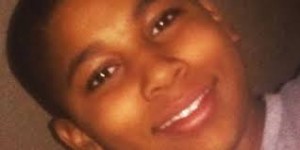
Tamir Rice
The youngest victim was 12 years old (Cleveland, Ohio)
Two were not engaged in any criminal behavior (Cleveland, Ohio and New York, New York)
Another one was guilty of only the most trivial of misdemeanors (a second incident in New York, New York).
Only one was engaged in any kind of violent behavior. He was shot at a range of 35 feet and the majority of witnesses stated he was trying to surrender (Ferguson, Missouri).
Also notable, only one of the above involved police investigating what was potentially a felony (that was not the Ferguson case, which initiated with a stop for jaywalking, but the Cleveland case, where a child playing with a toy gun resulted in a 911 call).
In each and every case, none of these men or boys should’ve died.

Michael Brown
In each and every case, the police engaged in some action or actions that escalated the situation, instead of de-escalated it (this is true in the case of Ferguson even if you accept the officer’s story as an honest accounting of the incident; as it happens, I do not believe the officer’s account). Put another way, all these deaths are more the consequence of the choices made by the person who lived than the person who died.

Death of Eric Garner
Though, in a longer view, police killings have declined (according to the CDC, police killings of Blacks specifically has declined 70% over the last fifty years, down to about four deaths per one million individuals), the tragedies of the last three months are proof enough that we desperately need to rethink policing, specifically in how it relates to low income communities and citizens of color (even with the drop noted above, the same CDC report demonstrates that Blacks are four times more likely to be killed by a cop than Whites, and one other ethnic minority group, Native Americans, are even more subject to police killings than Blacks).

Funeral of Eric Garner
Two reforms are obvious: 1) mandatory police body cameras (in cities where they are already in use, Use of Force incidents have dropped significantly, but also worth noting is that complaints about the improper Use of Force have dropped even more precipitously than the incidents themselves); and 2) local prosecutors clearly should not handle the Use of Force cases involving the local police forces that they need to maintain a good working relationship with (in the Ferguson case, during the Grand Jury hearing, Prosecutors had the Officer under Oath, but failed to cross-examine him; the same charge has been leveled against the Prosecutors in the second of the New York cases, but without the transcripts being made public, these claims can’t be confirmed).
 Law enforcement is inherently confrontational; the defining element of its daily interactions with strangers is the power of arrest. Moreover, law enforcement has become increasingly confrontational in the last two decades as dropping crime rates have been correlated with the application of the strategies of the “Broken Windows” policing philosophy. (The “Broken Windows” approach to policing is the notion that cracking down heavily on minor crimes will reduce disorder in the community which, in turn, will result in far fewer serious crimes.
Though “Broken Windows” has been given credit by some critics, it is actually difficult to establish a real causative relationship. Criminologist Richard Rosenfeld wrote in “Crime Decline in Context” (2002), “Homicide rates also have decreased  sharply in cities that did not noticeably alter their policing policies, such as Los Angeles, or that instituted very different changes from those in New York, such as San Diego.” Now, in response to the two New York deaths, evidence of disproportionate punishments for Blacks for minor crimes which Blacks commit in numbers roughly equal to Whites, and other pressures, New York City Police Commissioner William Bratton has promised a series of reforms that seem to re-arrange, if not dismantle, many of the tactics associated with “Broken Windows.” This is especially significant because two decades ago, Bratton was essentially the father of “Broken Windows” being applied in real-world policing.

Rumain Brisbon
I wrote this Thursday night. I put it aside because I was struggling to compose a concluding paragraph. I woke up Friday morning to see there had been another Police killing of an unarmed black man, this time in Phoenix, Arizona.
That makes it five in four months.
If you enjoyed this article, please consider sharing it!


8 Responses to In Case You Didn’t Understand Why Blacks Are Protesting the Police in 32 Different States
Leave a Reply
Purchase the Paperback and Receive the Kindle Version FREE

 Cicero's Dead is the intense debut crime thriller from Patrick H. Moore
 Boysie Blake: Problem Solver; the frightening debut thriller from Max Myers
 Telegraph Hill, the explosive debut thriller from John F. Nardizzi

Sorry, but the grand jury witnesses, who were black, say Brown charged Wilson and his hands were not up in surrender, not that facts matter.
Unarmed doesn’t mean one is harmless and does not have the potential to kill you, especially if he just tried to grab your gun.
Wilson is at fault for panic shooting. When an officer decides to use lethal force, he is to aim, shoot, and kill. Not keep firing until he finally kills. This is indicative of a panicked police officer and while understandable for a frightened homeowner confronting an intruder, it is not acceptable for a police officer. This does not mean Wilson did not have a right to shoot in self defens
This one will always be debated…
Well, the testimony is what it is. Why would black witnesses support the cop? Maybe because it is what happened?
Also, the fact someone is unarmed doesn’t mean they can’t kill you, especially if they already tried to grab your gun.
Working in criminal defense as I do, I tend to be skeptical of most testimony from both sides. Witnesses are threatened by prosecutors and their agents all the time both overtly and covertly.
That doesn’t prove the events didn’t occur as the witnesses testified. Any evidence these witnesses were threatened? Any evidence they lied? Why did they all say essentially the same thing? If anything, I would think they had more to fear for testifying for Wilson than against him.
Bear in mind that although Brown was a teenager, he was a very large man, and had just committed a robbery with violence against a shop-owner much smaller and weaker than himself.
Both during the robbery and in the confrontation with the police-officer, he acted very aggressively.
During the robbery and the subsequent confrontation, Brown was accompanied by a friend, who did not act in an aggressive or threatening manner during either incident. As a result, that friend came to no harm.
The case of Eric Garner was quite different. Although he physically resisted arrest, he was overcome and was lying on the ground, having ceased to resist. However, the police-officer continued to choke him, using an illegal hold, with the result that Garner died.
In that case I consider that the police-officer was not acting in self-defence, since Garner no longer posed a threat while he was lying on the ground and being choked, and therefore there should be a prima facie case of manslaughter or negligent homicide against that officer.
Or as Marge said: Michael Brown was no Little Bo Peep!
Totally agree with you Michael. The case of Eric Garner had no ambiguity. The man said 11 times he could not breathe.
But witnesses saw Brown harassing cop in his own car. And the only testimony that is completely contradictory to others is from his friend.
A lot of ambiguity in this one. I still think he should not have been killed, but he was not a great sample of police brutality. There are plenty of unequivocal cases out there. This one didn’t fit.