

Money Not Only Talks, It Swears, in Our Courts of Criminal Justice
by Rick Stack
Money (or lack thereof) typically has a HUGE impact on any given defendant’s ability to obtain a satisfactory outcome in his or her criminal case. An indigent defendant is appointed a public defender (“PD”) who has a large caseload and few resources with which to hire investigators to  visit and interview prospective witnesses and to review often voluminous discovery, in addition to hiring psychiatrists to explore possible mental defenses, and/or to hire expert witnesses such as eyewitness misidentification or crime reconstruction experts (note the slick computer-animated scene of Oscar Pistorius’ apartment that an IT/graphics designer prepared in his case).
 Due to their heavy workloads and trial schedules, PDs often have a much greater incentive than a privately-retained counsel to plead out cases quickly rather than to engage in extensive back-and-forth plea negotiations. This is a systemic problem with public counsel representation and is not meant to disparage the ability and dedication of many PDs. Even if an indigent federal defendant is assigned a private attorney from the Federal Indigent Defense
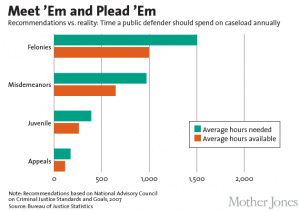 Panel, either because the defendant is part of a multi-defendant, case or the Federal PD is otherwise conflicted out, the Criminal Justice Act (“CJA”) offers paltry hourly reimbursement rates for private counsel — $126 for non-capital cases and $180 for capital cases. See http://fdwnc.org/wp-content/uploads/2014/04/CJA-HOURLY-RATES-Case-Maximums-updated-2014.pdf.
So, while the occasional millionaire or billionaire may receive a stiff criminal sentence, that is 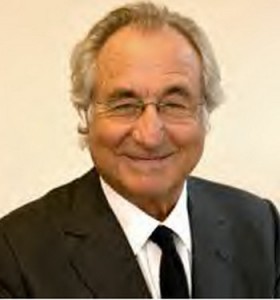 clearly the EXCEPTION rather than the rule. For every Bernie Madoff in prison for their criminal conduct which caused the greatest economic collapse since the 1930′s, nearly all other high-level financial miscreants evaded justice. How many Wall Street investment bankers or CEOs have been convicted and imprisoned for looting or similar offenses? How many bank executives were prosecuted for fleecing mortgagees and engaging in fraudulent robo-signing in connection with home loan foreclosures? We can probably count such prosecutions on one hand or, at most, two
 hands. In cases of corporate fraud, the usual “rule” is that the companies are required to pay a large fine (but nowhere near enough to materially affect their bottom-line profits) while the executives who authorized and approved the corporate criminality get off scot-free.
Federal Judge Jed S. Rakoff addressed that topic in his long essay published last year in the New York Times Review of Books. http://www.dailykos.com/story/2013/12/25/1265127/-Why-No-Corporate-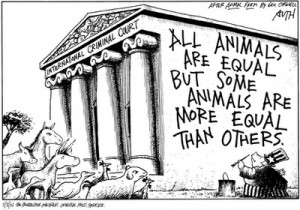 CEOs-Were-Prosecuted-For-Causing-The-Financial-Crisis. Bill Moyers also addressed this problem in his expose detailing the lack of prosecutions in the most recent financial crash compared to the numerous bank CEOs who were imprisoned during the S&L crash of the 1980′s. See http://billmoyers.com/2013/09/17/hundreds-of-wall-street-execs-went-to-prison-during-the-last-fraud-fueled-bank-crisis/.
So, in closing, to paraphrase George Orwell (Animal Farm), all people are created equal in the U.S. but those who are wealthy are “more equal” than others, especially in the criminal justice system.
 Rick Stack is a Los Angeles-based tax lawyer working in the private sector. Prior to that, he worked for many years as a Federal Prosecutor in the Tax Division of the U.S. Attorney’s Office. He resides in Los Angeles County and is interested in politics, civil rights, his family and the Chicago Bears. Rick is one of All Things Crime Blog’s earliest supporters and is known for his trenchant and unabashed comments.
If you enjoyed this article, please consider sharing it!



Great post Rick! To quote a man close to my heart, Charles Dickens
‘There are many pleasant fictions of the law in constant operation, but there is not one so pleasant or practically humorous as that which supposes every man to be of equal value in its impartial eye, and the benefits of all laws to be equally attainable by all men, without the smallest reference to the furniture of their pockets.’
Lise – I also love Dickens. It appears, however, that today’s elite conservatives want us to go back to the days of the 1850′s from which Dickens drew his inspiration, when the gap between the wealthy and the poor was huge. That gap, together with raising expectations among the people, led to the revolutions of the early 1900′s. Most of us definitely don’t want to go back to those bad old days.
Debtors prison comes to mind. The Conservatives definitely want to party like it’s 1850.
Unfortunately, debtor’s prisons have made a comeback in the U.S. in the last 30 years, despite tight budgets affecting the public sector. Many defendants who cannot afford to pay their fines or court costs are sent to prison. See https://www.aclu.org/blog/tag/debtors-prisons; http://www.latimes.com/opinion/op-ed/la-oe-harris-criminal-fines-20140608-story.html; http://dailyreckoning.com/beware-the-return-of-the-modern-debtors-prison/; and http://en.wikipedia.org/wiki/Debtors'_prison#Modern_debtors.27_prisons_.281970.E2.80.93current.29.
Although the Supreme Court ruled in Bearden v. Georgia in 1983 that only a person who “willfully” refuses to pay court costs or fines can be imprisoned and that judges must distinguish between who is too poor to pay, and who can but simply refuses to pay, judges hardly ever conduct that analysis. As a result, many people who really cannot afford to pay court costs and fines wind up in prison, like many of the citizens of Ferguson, MO. See http://www.npr.org/2014/05/21/313118629/supreme-court-ruling-not-enough-to-prevent-debtors-prisons; and http://www.npr.org/2014/08/25/343143937/in-ferguson-court-fines-and-fees-fuel-anger.
Rick, If you have time you should expand this into a short post. It would be a most worthy project. needs to be no longer than what we ran today.
Patrick – Is the photo in the upper left-hand corner of this post that of the teenager who killed 3 people in a DUI and received probation with the infamous “affluenza” defense? I wonder when the next wealthy defendant will use the closely-related Ebola defense? You know, the assertion that the defendant killed someone who he believed had Ebola, and thus, posed a direct threat to him and others.
That’s him. Ethan couch himself.
See, this is why all my murders are fictional. I can’t afford a good criminal lawyer.
Excellent piece, Rick. This problem extends to our death penalty, which is one (of many) problems I have with it. You don’t see rich white guys on death row, regardless of who they kill or how brutally they do it.
Thanks Darcia. Please keep writing about fictional murders.