

Vermont Parents Charged with Second-Degree-Murder in Alcohol IV Death of Severely Disabled Son
commentary by Patrick H. Moore
Life = Challenge after Challenge after Challenge. I suppose that without challenges we wouldn’t have the gumption to even wake up in the morning. Two of the toughest challenges that parents sometimes face are 1) maintaining proper (and stable) focus on the children if the marriage breaks up; and 2) caring properly (and lovingly) for a handicapped child whether or not the marriage is intact.
Therefore, we can assume that the penultimate challenge for a mother may be continuing to provide adequate and selfless care to a handicapped child when you have recently split up with your husband of many years and suddenly find yourself up to your ears in a relationship with a new boyfriend.
 The obvious question becomes: Can you put your own desires for love and intimacy with your new boyfriend aside sufficiently to continue to give your handicapped child the care he or she needs. And here’s where it can get really rocky: Suppose your new boyfriend resents the presence of your handicapped child who obviously requires a great deal of extra care?
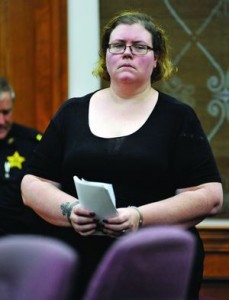
I bring this up (without jumping to any conclusions) because of a new heart-rending case out of Vermont where a mother, Melissa Robitille (a noveliest and book editor) and her new boyfriend, Walter Richters III (I don’t know what Walter does), are charged with second degree murder for allegedly poisoning Melissa’s 13-year-old handicapped son by placing a lethal dose of alcohol in his IV, which he required for daily fluids and medications.
 Let us read an entry from Melissa’s blog about her handicapped son from a year or so ago. At the time this was written, Melissa was still married to her former 64 year old husband:
 ‘Little Man’ is my son Isaac Robitille. He’s 12 and he has holoprosencephaly – an anomaly in which the fetal horseshoe-shaped brain doesn’t fully divide into two hemispheres. The doctors said he wouldn’t live to be six months old. He’s got a bunch of other differences, but he’s a delightfully happy little boy, loves math, hugs, kisses, and his dog (her name is Tickle – he named her!), and hates physical therapy. He speaks mostly tactile ASL. He was medically fragile for a long time after he was born, so writing took a back burner for me, but I can’t say that I regret it since I adore him and my skills as a writer have improved by leaps and bounds since 1999.
Based on Melissa’s blog entry, this last thing on earth we would expect is the news that she and her new boyfriend slipped alcohol into Little Man’s IV, allegedly to kill him. Yet, according to law enforcement, that’s exactly what happened.
Meg Wagner of the New York Daily News writes:
 A Vermont mom and her boyfriend killed her disabled son by dumping a deadly dose of alcohol in his IV tube, police said.
Melissa Robitille and Walter Richters III were charged with second-degree murder Tuesday for 13-year-old Isaac Robitille’s August death, WCAX reported.
Police believe the two poisoned an IV normally used for fluids and medications with liquor — when he died, his blood-alcohol content was .146, nearly twice the legal limit, police said.
Of note is the possibility that Isaac condition worsened between the age of 12, when Melissa wrote her blog entry, and 13 when he met his fate. It’s not clear to me at what age he first required a feeding tube and intravenous tubes to stay alive.
 In any event, on Aug, 22, Melissa called 911 to report she found Isaac dead and the toxicology report later revealed his blood’s high alcohol content.
Both Melissa and her boyfriend are in police custody in Hardwick, awaiting arraignment.
An article by Melissa Howell of WCAX News states that neighbors report that “they rarely saw the special needs child outside prior to his death.”
“I haven’t seen him for quite a while,” says Barbara Larabee, who lives next door. “Knowing he had all that to deal with and then parents that would do that, it’s just heartbreaking.”
Another next door neighbor, Elijah Morgan, says, “Family and stuff would help him in his wheelchair and stuff, walking around…I was outside playing basketball and I hear the ambulance going by.”
* * * * *
 First, I am a bit surprised that Melissa and Richters are only being charged with second-degree-murder, though I suppose putting alcohol in Isaac’s IV could have been a spur-of-the-moment decision in a fit of passion, pique or frustration.
Second, how are we to explain Melissa’s dreadful decision, notwithstanding whatever influence Richters may or may not have had on her? She had clearly sacrificed immensely for a very long time to maintain the best quality of life possible for her son, and based on her earlier statements, she loved him dearly.
But the parents of severely handicapped children sometimes reach a breaking point and suddenly engage in seemingly irrational behavior that is completely antithetical to their many years of self-sacrifice. This would appear to be what happened to Kelli Stapleton who has just been sentenced to 10 to 22 years for her attempt to end her daughter Isabelle’s life. Ms. Stapleton was allowed to plead to first-degree-child abuse in order to avoid the specter of a life sentence. At present, it is unknown if the Vermont prosecutors would be willing to contemplate a similar resolution in the case of Isaac.
If you enjoyed this article, please consider sharing it!



What a tragic story! It does seem that Melissa and/or her new boyfriend had reached the end of their ropes in caring for her special needs son. Unfortunately, it also appears that Melissa placed her romantic happiness ahead of the life of her disabled son.
I agree with you Patrick that I don’t see how this cannot be a case of first-degree murder. Then again, we are not privy to the same information that the prosecutor used in formulating the charging decision. Who knows, maybe the prosecutor in this case has followed the novel approach of not overcharging the defendants?
I did see one report stating that the alcohol is believed to be a secondary cause of death; the boy’s brain disease being the primary cause. Perhaps that’s the reason for the Murder II charge.
Interesting. If the brain disease would have killed the boy regardless of his alcohol poisoning, then the defendants may be able to obtain an acquittal on that basis.
That must be the reason for the lesser, albeit still serious, charge.
We both appear to be correct in our assessments. I predict that these defendants will ultimately plead guilty to an even lesser charge, like voluntary manslaughter. If so, it would make for an extremely interesting sentence mitigation case, n’est pas?
So we don’t know why he/she/they put alcohol in his IV tube? I imagine the reason why would explain the lesser charge. It sounds like they didn’t intend to kill him, possibly just using alcohol as ‘Mother’s Little Helper’, like in the Stones classic of the same name…
Rick, what does the 10-22 year sentence mean in real time for Kelli Stapleton? Will her time served count toward that? Does she have to do a minimum of 10 or only a portion of it before being eligible to apply for parole?
Does it make sense that she got such a lengthy sentence when no one actually died? She pleaded guilty to 1st degree child abuse, this wasn’t even an attempted murder charge… I am not downplaying the seriousness of child abuse but she is not some kind of repeat offender and it isn’t realistic to think she is a danger to other children, or even still a danger to her daughter for that matter… What are your thoughts on this sentence Rick and Patrick?
You could be right. On the other hand the boyfriend got quite huffy and said defensively, “The boys time had come”. or words to that effect. Still, twice the legal limit in a boy of 13 wouldn’t seem to be enough to kill him withut extenuating circumstances. On the other hand…
Since both the mom and boyfriend were charged with second-degree murder, it would appear that they acted in concert, regardless of which one of them physically placed the alcohol into the boy’s IV. Otherwise, if the boyfriend had poisoned the boy without the consent or knowledge of the mother, then she presumably wouldn’t have been charged with any crime.
As for the Kelli Stapleton’s sentence, the Autistic Self Advocacy Network (ASAN) issued a press release after the sentencing expressing its agreement with the sentence:
“K. Stapleton, having pled guilty to charges of first-degree child abuse, has been sentenced to 10-22 years in prison after poisoning her autistic daughter, Issy, in an attempt to end her life. ASAN is pleased that the sentence is consistent with the recommended sentencing guidelines. By imposing a similar sentence as would be expected for someone who committed the same crime against a non-disabled child, the court has sent the message that Issy’s life was as valued as any other.
“As ASAN outlined in our statement to the court at sentencing, people with disabilities are at great risk of suffering violence by caregivers. In the last 5 years, over 70 people with disabilities were murdered by their parents or caregiving relatives. It is imperative that the disability community be afforded equal protection from violence and these crimes be prosecuted to the fullest extent of the law. Troublingly, these crimes tend to see comparatively lighter sentences than filicides of nondisabled individuals.”
http://www.mlive.com/news/grand-rapids/index.ssf/2014/10/post_543.html
Thus, if ASAN knows what it’s talking about, I would not necessarily disagree with the sentence that Kelli received.
I’m sure that Kelli will be given credit for her sentence for time already served. Based upon my limited review (and “knowledge”) of Michigan sentencing law, my understanding is that convicted felons as to which sentencing discretion exists for their crime are given “indeterminate” sentences; that is, a range of time to be served. The maximum sentence is set by the legislature, which promulgates the maximum term to be served; the minimum sentence is determined by the judge based upon facts and circumstances and the characteristics of the defendant, with reference to discretionary guidelines set by the Sentencing Commission; and the parole board ultimately determines the amount of time within that range that the defendant will actually serve. Here’s a 14-year old article from the Michigan Bar association which explains the statutory sentencing scheme enacted in 1998. http://www.michbar.org/journal/article.cfm?articleID=92&volumeID=8.
In applying these principles to Kelli’s case, she will serve at least 10 years in prison (including her time served prior to sentencing) and no more than 22 years in prison, with the specific time actually served within that range to be determined by the parole board. Presumably, the parole board (as in other states) which would consider such factors as her behavior in prison, her remorse for the crime, her dangerousness to public safety, her chance of recidivism, etc. CAVEAT: I am not licensed to practice law in Michigan and I am largely unfamiliar with its criminal justice system, so this is only my best educated guess.
Thanks Rick. I disagree completely with ASAN. I think that that is a very slippery slope to traverse in saying a sentence reflects on the value of a life. Shall we look closely at examples of, say, minorities, the elderly, women killed by domestic violence to name just a few and see if the sentence received by their attackers are a reflection of how much value their lives have? I believe that the elevated number of these crimes for these populations is merely a reflection of how poorly society provides resources to help these communities with their needs. It is a knee jerk response to punish someone for a crime and state you are happy with the outcome instead of being proactive and saying we need to look at the underlying root cause of why 70 disabled individuals have been killed recently by their ‘caregivers’.
By this logic I must assume that any murderer put to death in this country must have killed someone whose life was of the highest value to us all since the perpetrator received the harshest sentence possible.
I am disgusted by the lack of empathy ASAN is showing for Issy and her entire family by not using this tragedy to try and raise awareness of a problem that is not going to go away with the current band-aids in place as far as help for people struggling with disabled family members’ individual needs.
I also think it is important to remember that Kelli did not kill anyone. Is her sentence still commiserate with others who have been convicted of 1st degree child abuse with no prior record of any kind?
Not only did Kelli not kill anyone but she tried to kill herself in the process wich indicates her level of despair.
ASAN is a disgrace
Judge Batzer gives a light sentence to a woman who killed her newborn, but throws the book at Kelli even if her child did not die.
Maybe her husband should be convicted of guilt by association. Felony murder for not rendering assistance while standing by. He was an abettor because he knew she was losing it and did not get the help necessary. Oh that’s right, they could not get the help they needed.
I am appalled by this verdict.
I can see both yours and Lori’s points about the sentence given to Kelli Stapleton. If this same judge gave a lighter sentence to a first-time offender who killed her child, then I would have to scratch my head a bit at the sentence given to Kelli. The sentencing scheme under Michigan law seems to resemble the non-mandatory nature of the Federal sentencing guidelines, so this judge clearly could have given Kelli a lesser sentence at the low-end of the indeterminate range.