

Raffaele Knocks Hard on Amanda Knox
commentary by Patrick H. Moore
Amanda Knox has been living the School of Hard Knox ever since that fateful day in Perugia when she and others discovered Meredith Kercher’s dead body in the upstairs apartment she shared with Meredith and two older Italian women.
The hardest knocks have been the two convictions, first in Perugia and more recently in Florence, and the four years Knox served in an Italian prison. At the Florence trial, it was observed that during closing statements, the prosecutor Alessandro Crini seemed to be tipping the scales against Knox, apparently viewing her as substantially more guilty than Raffaele Sollecito.
 On her blog, earlier this month, Amanda Knox did her best to control possible damage to their united front: “It has been claimed that, in this most recent round of closing arguments and in interviews since the latest guilty verdict, Raffaele and his defence attorneys have finally betrayed their resentment and started to put distance between him and me legally and personally.
“This is not the case. Actually, Attorney Bongiorno’s closing arguments and Raffaele’s latest statements pinpoint and attack a fundamental weakness in the prosecution’s case against both Raffaele and me that has been ignored for far too long: Raffaele is not a slave.
“Raffaele has plenty of reason for resentment, but not against me. The only reason he has been dragged into this is because he happens to be my alibi.”
Knox said that Sollecito had recently e-mailed her stating:
 “I don’t want to be punished for, nor have to continue to justify, those things that regard you and not me.
“Obviously the evidence demonstrates both of our innocence, but it seems that for the judges and the people this objectivity is of no importance.”
Knox’s attempt to rationalize this development in a manner supportive of Sollecito is, of course, commendable.
This week, however, a new knock has sounded in the engine compartment of this peculiar matter – Raffaele Sollecito, it appears, has taken affirmative steps to distance himself from Knox.
News.com writes:
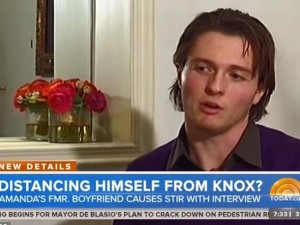 Amanda Knox’s ex- boyfriend Raffaele Sollecito has revealed he has unanswered questions about her behaviour after the murder of her roommate Meredith Kercher.
In an interview that aired on Italian TV, Sollecito said that Knox left his house the morning before Kercher’s body was found and when she returned hours later, she seemed “very agitated”. She said her front door had been broken into and that she had found spots of blood in the bathroom.
Although some will disagree (people disagree about everything in this infernal case), it can be argued that Knox’s trip back to her apartment was the first time she and Sollecito had been separated since they retired to his place the previous evening to smoke cannabis, make unca nunca, and do whatever else young people do when wrapped in the rapture of youthful desire.
In his interview, some of which aired on the Today show in the US, Sollecito didn’t seem to be in an unca nunca mood.
“Certainly I asked her questions,” he said. “Why did you take a shower? Why had she spent so much time there?”
Logically enough, the interviewer asked the skeptical Italian what answers Knox provided to these questions.
“I don’t have answers,” he replied, which presumably means Knox didn’t provide adequate or satisfactory answers.
In the eyes of NBC legal analyst Lisa Bloom, Sollecito seemed to be distancing himself from Knox with these latest comments.
“He’s saying that there’s some evidence that may apply to her that doesn’t apply to him.”
Is Sollecito suggesting that Knox messed with the evidence during her extended trip to her apartment? Possibly so, but consider these simple possibilities:
1) Knox and Sollecito spent the whole evening at his apartment and took no part in the killing.
2) Knox and Sollecito were at the American girl’s apartment at around the time of the murder and took part in the slaughter.
3) Either Knox or Sollecito separately left the Italian’s apartment during the evening, went to Knox’s apartment and took part in the murder.

In the event it was #3, it stands to reason that the other party would have probably divulged the fact that one of them left Sollecito’s place during the evening, thus suggesting the party who left could be guilty of the murder; meanwhile, the one who remained behind, distances himself or herself from the murder.
Now it wouldn’t make much sense for Sollecito to have gone alone to Knox’s apartment, so if someone did go alone it was most likely Knox unless Raffaele chivalrously made the trip to run an errand for her and took part in killing Meredith Kercher in the process? No, whatever happened, it didn’t come down that way.
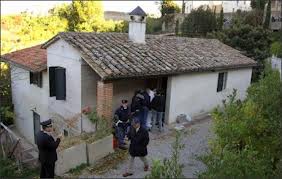 If — and I’m not saying this is what happened – Knox left Sollecito’s apartment during the evening, went to her place, took part in the murder and then returned to Raffaele’s apartment, it makes some sense that she could have gone back to her place in the morning to tidy up a bit.
But if she had left during the evening, as stated previously, Sollecito would have been aware of it and probably divulged it to protect himself, unless he was asleep and didn’t know she had left. But up to this point, to the best of my knowledge, he’s said nothing of the sort.
Therefore, this attempt on his part to distance himself from Amanda by casting doubt on her activities during her morning trip to her apartment seem a bit mean-spirited. Is he hoping to get his sentence reduced by a few years because Knox may have tampered with the evidence, obstructed justice, if you will? I guess anything is possible at this point.
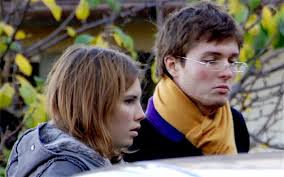 I still believe, however, that his is essentially a package deal. If Sollecito’s second conviction is overturned at the next appeal, Knox’s conviction will also be overturned. And vice-versa. And if their convictions are not overturned, Sollecito probably will get a somewhat shorter sentence…but it will still be awfully long.
Meanwhile, Amanda Knox must be reeling even more than usual from this most recent Hard Knock. One wonders how many more such knocks she can stand.
Click here to view our earlier Hard Knocks post:
If you enjoyed this article, please consider sharing it!



“But if she had left during the evening, as stated previously, Sollecito would have been aware of it and probably divulged it to protect himself….
But up to this point, to the best of my knowledge, he’s said nothing of the sort.”
I agree that his suddenly having something to divulge now makes no sense, apart from the complete absence of evidence of either of their involvement, but I would hold off on calling him mean-spirited. I have been irritated all week about all these TV pundits who know very little about the case apart from the media hype making irresponsible remarks suggesting he is now “coming clean”. I have not had a chance to hear the original in Italian and suspect that in translation, as has been the perverse case all along, the meaning has been somewhat distorted, and inevitably distorted to Amanda’s disadvantage.
When I have examined the source material and perhaps even asked Sollecito himself if I get a chance, I will communicate my findings.
Great! Excellent! Very disconcerting to have Raffaele saying these things. Would be good to get to the bottom of it.
Raffaele says in “Honor Bound” that Knox could not have left his apartment without his knowledge, because she had no keys and would not have been able to get back in.
On pages 65-66 of her memoir Amanda explains why she took a shower in the “bloody” bathroom. She saw only two or three tiny droplets of blood on the sink, and thought this weird, but says she certainly did not think the worst — that someone had been murdered.
Google Raffaele’s Katie Couric interview and you will find Raffaele explains the very behavior by Amanda for which he recently said he has no answers. See Couric interview at 6:17 to 7:51. He gives the same explanation as Knox, that tiny specks of blood were “curious” but no reason to think someone had been murdered. And the footprint on the bathmat he says looked more like a water mark and it was not clear that it was blood.
Raffaele is clearly in a very tight spot. When the ISC confirms this latest conviction, he will be imprisoned for 25 years and the estate his deceased mother left in escrow for him will be liquidated and disbursed to the Kerchers and their civil attorney Maresca.
Under such circumstances, his remarks have obvious and desperate ulterior motives that have nothing to do with innocence or guilt.
“lookingglass” posted on Injustice thread:
“He has done so many interviews now. I don’t think it’s curious, it was natural and comes straight out from the heart with honesty and spontaneity. The fact that he nowadays seems reluctant to interpret her actions so precisely, simply means, to me, that he is now fighting for his own life and doesn’t want to get embroiled any longer in what Amanda did or didn’t do or to speculate any further about it.. I am sure he is NOT distancing himself from her or attempting to deny anything he has already said about her.
“He has been advised to concentrate on questions that concern him and him alone. However I think ultimately this is impractical and a waste of time. It has led already to the sensationalistic headlines that he is ‘disowning’ or ‘doubting’ her, because it sells papers and puts up ratings. The media are all b****ds.
“I just want to add that I think this young man is one of the most moral and sensitive people I have come across in a long time. He has a fine sense of values. He says here and in other interviews too that ‘….if I threw Amanda under a bus and I was free I could not live with myself.’ I wonder how many other young men in his dire situation would have said the same of a girl they only knew for such a short time. True love maybe, but he also possesses a remarkable and impressive human spirit.”
Mark,
Thanks very much for this insightful and sensitive comment.
Exactly – all those sensationalist photos of the bathroom awash in light red as though swimming in blood are those that show the way luminol reacts with many different organic substances, not just blood. Those photos were quite deliberately put about without that explanation to make it look as if Amanda must have been crazy – or guilty – to have taken a shower in such a literal blood-bath.
Again, the prosecution and media counting on the stupidity and shallowness of an alarming number of people. Anyone who does minimal research can see that this whole case has been a medieval farce of ridiculous confabulation. Unfortunately, too many people are academically illiterate and/or lazy and have no idea how to research even the most basic claims so they believe the nonsense put about by those with an agenda to bolster.
Knox has twice undermined Sollecito’s reasoning for why he realized she couldn’t have gone out (a statement he only made in his diary, not in court BTW). Knox has twice stated that when she came home the next morning, Sollecito was in the bathroom. She never states that she had a problem coming in or that he let her in. Somehow, after leaving while Sollecito was still sleeping, on 2 Nov Knox can let herself back into the house while Sollecito was in the bathroom, but the evening of 1 Nov Knox couldn’t get back into the house without Sollecito opening the door for her?
You are obviously unfamiliar with the structure of many, if not most Italian apartment buildings. People usually let the person in through the street door by an intercom but to let them into their actual flat they have to open the door to that separately. It is quite conceivable that he let her in the main door by pushing the intercom button then went to the loo while leaving his own door ajar while she made her way across/up the building to his flat. This kind of thing has happened to me countless times. You ring the bell, you hear nobody’s voice but the street door clicks open then when you arrive at your host’s flat they are nowhere to be seen initially, only to emerge a few seconds later from another room. As usual so many assumptions based on a non-Italian perspective. This was not a “ranch” where he let her straight in to the living room from the covered porch.
“I left and went back to raffaele’s, and kept brooding over it, and he was in the bathroom, and I kept brooding over it. I had a mop [...] I was mopping that up, and immediately after he got out of the shower.” -Amanda Knox 2/25/2014
“By that time, I was back at Raffaele’s he was in total vacation mode: he’d slept in and had just gotten out of the shower. I’d forgotten about our trip.” -Amanda Knox, Waiting to be Heard, 2013 (No mention of mopping)
“and i returned to raffael’s place. after we had used the mop to clean up the kitchen i told raffael about what i had seen in the house over breakfast.” -Amanda Knox, email home, 4-Nov-2007
” I walked back to Raffaele’s house and together we started mopping [hi]s floor. He began, but he went to put on his clothes I finished [m]opping up the water.
Then we had breakfast. Over breakfast (cereal, coffee, biscotti) I [to]ld Raffaele about what I had found at my house. He said I should [ca]ll one of my roommates.” -Amanda Knox letter to layers, 9-Nov-2007
Not one consistent story about coming back to raffaele’s on the morning of the 2nd. Never one mention of consistent details, like being let back in, or where raffaele was, or what he was doing when she got back on the morning of the 2nd.
Knox’s alibi rests on Sollecito’s revelation that she couldn’t have come back in on her own, yet she has said on multiple occasions he was in the bathroom or showering when she returned.
I’m not sure what kind of legal advice, if any, Amanda obtained before deciding to write and publish her tell-all book. Unless and until her Italian conviction becomes final, any statements that she makes in her book which are inconsistent with her prior statements can be used against her in court (I’m not quite sure how that principle operates in the Italian appellate process). Any criminal defense attorney worth their salt will tell a murder defendant to shut up and NOT say anything about the case to anyone besides counsel until the case is completed, especially to the media or in a book. In most cases, defense counsel also advise their murder defendant-clients not to testify at the trial.
I’m not that familiar with Raffaele’s apartment but…
The account of the neighbor who needed a ride to the airport suggests it was a security building with a speaker, which the neighbor used to speak to Raffaele and Amanda on the night of the murder without either of them coming to the door. If he wished, Raffaele could have buzzed this neighbor in without having to come down to the door to let her in.
When Amanda went out, he would have buzzed her back in when she called on the speaker in the same way.
Obviously, when Raffaele left, he could not buzz himself in, and would have to use his security key.
If this is corrAgain But Amanada should have written: “When I returned to Raffaele’s building, I buzzed his apartment. He said, ‘Hello, who is there?’ I answered, ‘It’s me, Amanda. Will you let me in please?’ He said, ‘Yes I’m in the bathroom, but come on in.’ Raffaele buzzed me in and when I went upstairs he was in the bathroom.”
I understand that Amanda’s book was over length and the publisher made her cut 100 pages. It is possible that a passage such as the above was among the cuts.
Thanks Mark, this tallies with what I suggested. It could also be that Amanda didn’t even think to have to explain the system of entry as, after all, it is not that unusual even in the States. I guess her mind wasn’t jumping ahead to thinking that people would construe sinister intent from her simply stating that she got back to Raff”s place. The details that you filled in would no doubt also seem pedantic and overly banal to a publisher who also would not make that leap to how some would dissect it. If she mentioned he was in the loo, again, in and of itself somewhat banal and TMI, but in the context it communicates that she was anxious to see him and be reassured. If she had found nothing unusual at home and had not been disturbed, his being out of sight for a couple of minutes would have been inconsequential and she would not even have remembered it.
Yep pitchforks, I was being a little satiric my post to illustrate how absurd it would have been for Amanda to document every little detail of everyday life.
I appreciate your insights into Italian apartments. Have no experience with them. I learn from your posts.
Here’s another version where Knox is VERY clear that Sollecito was in the bathroom when she got back:
“So um, I thought, strange, okay, let’s see what Raffaele says, because I didn’t know what to think, and so I wanted to talk it over with him. When I got back to his house, I…he was in the bathroom, and I started to clean up the floor in the kitchen, but it was by now almost dry, just a bit of water left because it had evaporated. Then he came out and we made breakfast, and while we were preparing it and drinking coffee, I explained to him what I had seen, and I asked him for advice, because when I went into my house, everything seemed in order, only there were these little weird things, and I couldn’t figure out how to understand them.” -Amanda Knox trial testimony, June 2009
Sollecito’s version; no mention of the shower or the door:
“Amanda woke up before me that morning and I could not manage to get up. I therefore stayed so I could sleep some more [sono rimasto a dormire] while she went to shower at her house. I do not remember if I had breakfast before or after Amanda returned to my house. I do not remember how she was dressed on November 1 [sic], but I am sure that she had changed and that she had put on the white skirt and her usual black hiking shoes. She was cleaned up and she had brought me a Vileda mop [mocio Vileda] in order to help me dry the floor around the sink. The previous evening I had placed only a few rags on the floor and they were not sufficient. After having cleaned the floor and perhaps having had breakfast at around 11:30 ‐ 12 noon, I got changed and we went out.
Meanwhile, she had spoken to me about the fact that she had found something strange at her house. ” -Raffaele Sollecito diary, 7-Nov-2009
“By the time she returned, I was up and in the kitchen making coffee. I was up and in the kitchen making coffee. I could tell something was bothering her, but she didn’t say what it was. She’d brought the mop, so I spent some time wiping up while she poured our coffee. Then we sat down to breakfast. Only when we were close to finishing our cereal did she finally tell me what was on her mind.” -Raffaele Sollecito, Honor Bound, 2012
I am very pleased to see the discussion of the Knox case being conducted in such a civil manner. Everyone knows that people on both sides of the fence feel very strongly about this case and in the past, commenters have gotten a little berserk over some of the posts we’ve run, both pro and anti-Knox..
Pat, You should consider writing a formal post for us in which you argue this issue from your side. I would be delighted to post it if you would consent to writing it.
Pat A –
In none of your above posts does Amanda say she got back into the apartment WITHOUT Raffaele having buzzing her up.
It is possible while raffaele was asleep, Amanda left and killed Meredith, and somehow returned and slipped back in bed.
Similarly, when Raffaele writes: “By the time she returned, I was up and in the kitchen making coffee,”
is not not possible that she buzzed, he rang her in, and resumed making coffee?
When Amanda writes, “When I got back to his house, I…he was in the bathroom, and I started to clean up the floor in the kitchen” is it not possible that she buzzed, Raffaele came from the bathroom to buzz her in, and returned to the bathroom?
If it is not possible that Raffaele buzzed her in, then how is it possible Amanda was in bed when Raffaele went to sleep and when he awoke, but was not there in between?
They do not explain one way or another how Amanda got back into the apartment; she might have scaled the wall like Rudy and entered through a second floor window. I doubt they are concealing anything; more likely they did not think it worth mentioning every piece of trivia.
It was not relevant at the time. Because they stayed together there it was obvious to both of them how Amanda got into the apartment, and did not occur to them that others might wonder about this.
That you would seek to hang a murder on this astonishes me, though nothing about this case should anymore.
Being an apologist for comments you haven’t even familiarized yourself with? She most recently gave the same version of the story in the 2-part 40 minute recorded interview with the UW student newspaper. She is very clear about Sollecito being in the bathroom when she gets back, and having to wait for him to finish in the bathroom to talk to him. Your dissembling about the length of the book is irrelevant, particularly when it is something as important as Sollecito’s sole reason that he says in the media (but not court) that Knox stayed home.
No, the story is absurd on its face. Police in the interrogation bullied Raffaelle into admitting although she spent the night with him, it was “possible” while he was asleep she took a knife from the kitchen, slipped out and killed Meredith, washed and put back the knife, and slipped back into bed with him.
This was no evidence or remote reason to believe such an absurd speculation.
It is somewhat akin to the problem of identity in a philosophy class:
Suppose you are sitting in a chair at your desk at home. You break from work and go out for lunch. When you return, your desk and chair are still there. But are they really? Could not someone have slipped into your apartment while you were gone, stolen your chair, and replaced it with another that looks exactly like it? If the chairs are a perfect match, you must entertain the “possibility” that the chair in your home is not the same chair that you sat in before lunch.
Similarly, the police argue that although Amanda was there when Raffaele went to bed and when he woke up, it is “possible” that she slipped out and killed Meredith between those two moments.
While it is indeed “possible”, like the switching of chairs, there is no reason to think it happened.
Logician Bertrand Russell wrote that to say something is possible merely means it is not a logical contradiction.
It is in this sense a trivial assertion.
The forensic evidence is solid that Amanda was NOT in the murder room that night. Since she was in bed when Raffaele went to sleep and when he woke up, the most reasonable assumption is that she was there that night.
I have seen the video, and she does NOT state that she entered the security apartment with her own key.
She does not say that Raffaele buzzed her up either.
She simply says what Raffaele was doing when she returned.
I’m not hanging a murder on the lack of detail, but Sollecito is hanging Knox’s innocence on a detail that they never mention on any other occasion, a detail which Knox herself contradicts when she says repeatedly that Sollecito was in the bathroom when she returned and she had to wait for him to get out of the bathroom.
Should police have taken Sollecito’s whole story to Knox and just said “here’s what he’s saying, do you agree with it?” Or should they have separated the two of them, asked them their versions of what happened, then see where they don’t add up? And the stories didn’t add up- Sollecito claimed for weeks that he couldn’t say that Knox stayed with him that night. Even years later in his book, his excuse still doesn’t give her alibi support; he himself admits that if he had access to a calendar to see what day it was, he would have seen it was thursday and he would have told the police that that was the day she works so she must have gone out. Six years later he still claims that he would have told the police Knox went to work on thursdays, and thus would have been out of the house the evening of the 1st.
RE: “Sollecito is hanging Knox’s innocence on a detail that they never mention on any other occasion.”
Not true. How does Amanda’s innocence hang on whether or not she had a security key to Raffaele’s apartment?
The key to her innocence is that she was not in the murder room that night. All forensic evidence belongs to Rudy Guede and Meredith Kercher.
It doesn’t matter where Amanda was that night, because we know for certain where she and Raffael were NOT.
The lack of clear, compelling evidence (or motive) linking Knox and Sollecito to the murder would seem to render minutiae about comings and goings irrelevant. They need to get back to basics with that case. “Do we have any evidence to justify a conviction or not?” Unfortunately, many of the authorities seem to be playing a political game that is more concerned with saving face than seeking justice.
It’s sollecito himself who made this minor detail a bigger deal when he claimed it was the sole reason why he could definitively say Knox didnt go out the evening of the second. If you have an argument against focusing in a seemingly minor detail that sollecito now claims is key to supporting knox’s alibi (in the media) then take it up with him.
Like most of their stories between the evening of the 1st and the arrival of the police on the second, his claim doesn’t mesh with other statements and events. But then again, how much trust should you put in the public media statements of two murder suspects who have had their convictions upheld?
It occurred to me that the person who finds a body is naturally a suspect unless they can show the police otherwise. If Amanda found Meredith’s body, it strikes me as very strange that she casually returned to Rafael’s flat for breakfast. Why didn’t she immediately call the police upon finding the body? She made herself a suspect by her bizarre stories and inconsistent statements.
But did she actually find Meredith’s body by herself? She found the front door open and the house in some disarray butI believe Meredith’s door was locked which was why her room had to be broken into.
Patrick — My understanding is that Amanda wrote that she went back to Rafael’s house on the morning of November 2nd to discuss with him the discovery of Meredith’s body. I don’t know whether she personally discovered the body or was merely at her house when it was discovered by others. (This is an illustration of the risk of pontificating on a subject when one hasn’t read and reviewed the actual evidence; unfortunately, I don’t understand Italian!).
RE: Rick writes: “My understanding is that Amanda wrote that she went back to Rafael’s house on the morning of November 2nd to discuss with him the discovery of Meredith’s body.”
Rick is way off.
The body was discovered by Filomena and Postal Police when Filomena’s boy friend kicked open the locked door to Meredith’s room (the Postal Police were not allowed to do so because as yet they had no evidence a crime had occurred in the room). Amanda was elsewhere in the house when they did this and never even saw into the room.
Thanks for making this clear, Mark.
One of the many controversies resulting from kicking open the door is that a Postal officer immediately entered the room and looked under the duvet to discover Meredith slit throat. By entering the crime scene he contaminated it, and possible tracked blood elsewhere in the house, mixing it with (e.g.) Amanda’s DNA which one would expect to find randomly in the house where she lived.
At trial this officer went up against Folimena’s boy friend. The officer denied having entered the room, while the boy friend says absolutely he did. Filomena was hysterical and of little help.
Merely to clarify for Rick….
(1) That morning Amanda went home to shower and change for a day trip. The front door was open, but not that strange because the door was faulty and often opened on its own. She noticed 2 or 3 tiny blood droplets on the sink, which she thought curious but says she certainly didn’t think the worst — that someone had been murdered. After showering and changing, she went to blow dry her hair in the other bathroom and found stool in the toilet. This creeped her out, and she left.
(2) Amanda returned with Raffaele, and they checked out the other rooms. Laura’s was immaculate, Meredith’s was locked, but Filomena’s had the window shattered with glass all over the floor. Raffaele called the police, and he and Amanda went outside to wait for them.
(3) While waiting outside, the Postal Police arrived to return two of Meredith’s cell phones that had been found in some bushes. Raffaele thought they were the police he called, and persuaded them to come inside for a look. Amanda had called Filomena, who arrived with her boyfriend.
(4) Filomena’s boyfriend kicked open Meredith’s room, and a postal officer entered and lifted the duvet to discover Meredith with her throat slit.
Thanks for that recap, Mark. As I’m by no means an expert in this case, it’s difficult to keep the factual chronology straight.
Given that everything about the Italian court is entirely fixed, and decisions are completely unrelated to evidence or logic, I guess Raffaele could be angling for his conviction to be quashed, while Amanda remains conveniently in the US convicted.
The Italians have no wish to convict Raffaele, it’s only Amanda.
Welcome to the Italian Supreme Court.
Or as we say sometimes, “The fix is in!”
It’s called desperation. When there is nothing of probative value they resort to worrying about idiotic trivia that people muddle up all the time. “Wait, was it asparagus I bought on Wednesday or was that Thursday….Ooops, I think I told them I bought aubergine on Wednesday, but no, wait, I bought the aubergine at the commissary because they didn’t have it in Giant and we went to the commissary on Friday…or was that Thursday after I went to the dentist…. Oh god, is the asparagus still in the fridge or did we eat it….??? If I can’t produce the asparagus then I’m going down….!!!”
“if I can’t produce the asparagus I’m going down….!!!!” Classic line describing the Insanity factory!
Or, to paraphrase the catchphrase that the advertising boys on Madison Avenue came up with during the O.J. trial: “If the asparagus does not fit, you must acquit.”
Rick wrote:
“It occurred to me that the person who finds a body is naturally a suspect unless they can show the police otherwise. If Amanda found Meredith’s body, it strikes me as very strange that she casually returned to Rafael’s flat for breakfast. Why didn’t she immediately call the police upon finding the body? She made herself a suspect by her bizarre stories and inconsistent statements.”
This is an extremely important point.
I have previously expressed the view that Sollecito and Knox may have discovered the murdered body of Kercher fairly early on the morning of 2 November 2007, and staged a break-in to create the impression that the murder had been committed by an unknown intruder.
The above comment by Rick is a precise statement of their motive for doing so, if that is in fact what they did; having discovered the body alone, without any witnesses to their discovery, they feared being themselves accused of having committed the murder.
That fear would have been compounded by the fact that the murder would have appeared to have been committed by someone connected to the house, someone who had been admitted by one of the residents, and since all the residents except Kercher and Knox were absent on the night of 1-2 November, the person who committed the murder would have to have been admitted by either of those two.
Since Kercher was the victim, and would not be presumed to have admitted her own murderer to the house, suspicion would automatically fall on Knox.
The above considerations would, to my mind, have provided the motivation for their possible decision not to notify the police immediately, but rather to tamper with the crime scene in order to eliminate themselves as suspects. Their aim could have been to ensure that the murder was “officially” discovered at a later time when there were plenty of witnesses to the discovery, ie later in the day when some of the other residents had returned.
In the above hypothetical scenario, it would most likely have been Sollecito who would have suggested not calling the police immediately but staging a break-in and then reporting that incident only, since he rather than Knox would have had a full appreciation of the endemically corrupt nature of the Italian political and justice system, and would have been aware of the danger of Knox’s falling under suspicion and being coerced into making a false confession.
Unfortunately for Sollecito and Knox, if the apparent break-in was indeed staged by them, then the staging was very clumsy, since it involved the most difficult and least likely entry point for a burglar; it was immediately obvious to the police that the break-in was staged, and that is what aroused their suspicion of Knox, she being the only person who could have given the murderer access, apart from Kercher herself.
The line taken in the police interrogation of Knox on the night of 5-6 November strongly suggests that they suspected her, not of the murder itself, but of having given access to a person who subsequently committed the murder. That is why, when a police technician traced the exchange of text messages between Knox and Lumumba at around 20:30 on the evening of 1 November, they believed they had found the “smoking gun”; an arrangement between Knox and Lumumba for her to admit Lumumba to the house for the purpose of his having sexual contact with Kercher. Up the that point, the actions of the Italian police were entirely rational, and in no way conspiratorial or corrupt.
Where the Italian police went dramatically wrong was their failure to consider that Kercher herself may have admitted the person who subsequently murdered her, even though Guede, in his first statement to the German police on 21 November 2007 explicitly confirmed that he had been admitted to the house by Kercher shortly before 21:00 on 1 November, for the purpose of a sexual liaison.
I consider the statement by Guede to be most probably true, since it is consistent with the testimony of Kercher’s British friends that she left them shortly before 21:00 in order to return to her house, with the excuse that she needed to study. It is entirely possible that she wished to conceal from them the fact that she had arranged a liaison with Guede, a rather louche character.
The recent statements by Sollecito may be an indication that he has realised that the story he and Knox have told about their actions on the morning of 2 November is simply not holding up, and that he is moving toward a version of the truth that most favours himself.
If he admits that Knox returned to the house alone quite early on the morning of 2 November, that would be most probably true. Since they were planning an excursion to Gubbio on that day, they would almost certainly have risen early, which would be consistent with the evidence of activity on Sollecito’s computer before 06:00 on that day, and also of his mobile phone being switched on just after 06:00. Knox’s return to the house could be explained in terms of a need to obtain fresh clothes for the planned excursion.
If he then claims that she did not return for several hours, until late in the morning, then it is most likely that he is “massaging” the truth in order to protect himself. If Knox did return to the house and discover the body of Kercher, then she would have been profoundly traumatised, and would almost certainly have run back to Sollecito’s apartment in a panic to tell him what had happened.
Under this scenario, which I stress is hypothetical but not at all improbable, the most likely course of events is that Sollecito would have spent some time calming Knox down, and then returned with her to the house to see for himself what had happened, and to try to work out the best course of action in such an extreme and shockingly unexpected situation.
If the crime scene was indeed tampered with, if the break-in was indeed staged, the most logical conclusion is that both Sollecito and Knox were involved; it is extremely unlikely that it could have been done by Knox alone while Sollecito stayed in his apartment wondering why Knox was taking such a long time to collect a few things for their excursion to Gubbio.
In tampering with the crime scene, Sollecito and Knox would have had two crucial problems to solve;
1. how to make it appear that Kercher had been killed by an intruder; and
2. how to explain the fact that they had not discovered that a murder had been committed.
The first problem would have been solved by staging a break-in, to make it appear that Kercher had been killed when she disturbed a burglar. The second problem would have been solved by locking the door to Kercher’s bedroom, making it appear impossible for them to have seen her body.
In summary, I believe that the anomalous features of this case can be explained by the presumption that Guede alone murdered Kercher at around 22:00 on the night of 1 November 2007, that Sollecito and Knox discovered the murder the next morning, and that they perpetrated a cover-up out of fear that they might wrongfully come under suspicion.
Michael Mills is way off.
It was the postal police who found the body and contaminated the scene by entering the room, tracking contamination from outside into the room, and then tracking evidence from the room all over the apartment. Evidence from the room was thus intermingled with DNA and other evidence in the apartment where Amanda lived.
There is no record of Amanda and Raffaele having found the body earlier. That they “might” have done so is simply made-up talk based on personal dislike of Knox by Mr. Mills.
Mark – If you read Mr. Mills’ earlier posts on this site, you’d realize that he does not dislike Amanda Knox and that he has analyzed the evidence with a view toward exculpating her of any involvement in the murder of Meredith Kercher. I find Mr. Mills’ approach to be quite “fair and balanced” (unlike Faux News).
For the record, I neither “like” nor “dislike” Knox.
What I am trying to do is find an explanation for the conflicting anomalies in this case.
On the one hand, the story told by Sollecito and Knox of their activities on the morning of 2 November 2007 is implausible, and there are clear signs of their having doctored the crime scene to make it appear that the murder was committed by an unknown intruder who broke in. That implausibility suggests that they are concealing something, perhaps their involvement in the murder (that was the conclusion of the Prosecution).
On the other hand, all the physical evidence points to Guede as the sole murderer, a conclusion that is supported by his own admissions about having been present in the house at the time of the murder and having witnessed Kercher dying.
The only way Sollecito and Knox can be connected to a murder in which Guede was clearly involved is to assume some sort of prior arrangement between them and Guede. However, on the evening of the murder, both Sollecito and Knox were expecting to be fully occupied, Knox at her normal job at Lumumba’s bar and Sollecito giving a lift to Popovic to catch a bus; it was only at about 20:30 that evening that they were unexpectedly released from those obligations, Knox by the message from Lumumba telling her not to come in to work, and Sollecito by Popovic coming to his apartment and telling him she no longer needed the lift.
The most recent judgement against Sollecito and Knox by the Nencini court explicitly recognises that fact; indeed it found that their involvement in the murder was purely opportunistic and not pre-planned.
The big hole in that finding is that it fails utterly to explain the presence of Guede at the crime scene when the murder was committed, which is absolutely not in doubt. If the alleged involvement of Sollecito and Knox were purely opportunistic, and would not have occurred if their expected activities had not been cancelled (as Nencini explicitly found), then they could not possibly have made a prior arrangement with Guede to go to the house to do something to Kercher.
If Sollecito and Knox could not have made a prior arrangement with Guede, then the latter’s presence in the house during the murder cannot be explained in terms of actions by Sollecito and Knox. It follows logically that his presence in the house was a result purely of his own initiative and not of anything done by Sollecito and Knox.
Since there is nothing to tie Sollecito and Knox to Guede at the time of the murder, and only the physical presence of Guede in Kercher’s bedroom after the attack on her is indicated by the forensic evidence, and also confirmed by his own statements, it follows logically that Sollecito and Knox were not present together with Guede, and that therefore Guede alone committed the murder.
It is for the above reasons that I consider it highly improbable that Sollecito and Knox were involved in the murder of Kercher in any way. However, their actions on the morning of 2 November still need to be accounted for, due to the implausibility of their account and the indications of tampering with the crime scene, and that is what I have tried to do.
In short, an unbiased examination of the crime scene as it was found on 2 November 2007 does strongly suggest that Sollecito and Knox were not telling the truth and were concealing something.
On the other hand, an unbiased examination of all the evidence pertaining to the murder itself, and to the actions of Sollecito and Knox up until about 20:30 on the evening of the murder, must lead to the conclusion that they were not involved in the murder but were in Sollecito’s apartment when it was being committed.
Accordingly, the anomalies in their account of their actions on the morning after them murder must have some explanation other than that they were trying to conceal their own guilt, and the hypothesis put forward by me represents an attempt to offer such an explanation.
RE: Mr. Mills: “…the story told by Sollecito and Knox of their activities on the morning of 2 November 2007 is implausible, and there are clear signs of their having doctored the crime scene to make it appear that the murder was committed by an unknown intruder who broke in. That implausibility suggests that they are concealing something, perhaps their involvement in the murder (that was the conclusion of the Prosecution).”
None of the above is true. It is pure nonsense. I am a little hard on Mr. Mills because he wasted a great deal of time with this theory on the Injustice in Perugia thread. My sense there was that he was attempting to neutralize that thread by diverting it into an argument over nonsense. I do not feel Mills believes the things he is writing, but that it would amuse him to distract others into taking him seriously and wasting time debating his ideas.
There was no clean up. Amanda’s fingerprints were not found in her own bedroom because an officer admitted at trial they did not look for them there. “No, why should we?” he said. He admitted they looked for them in the murder room, but found only prints from Meredith and Rudy Guede.
The common areas of the apartment had many unidentified prints which police did not attempt to identify (“We didn’t try to see if they belonged to Obama,” said one officer.) Traces of both Meredith and Amanda’s DNA were found in these common areas of the house in which they lived. If the premises had been bleached, no prints or DNA would have been found in the common area.
It is not possible for Amanda and Raffaele to have entered the murder room and rearrange the body and do other mischief without leaving some trace of their presence. The stupidity of Mr. Mills’ suggestion that they stumbled across the body and rearranged it for fear they would be blamed is unworthy of serious consideration. Amanda and Raffaele had no motive to murder the girl, and no reason to feel suspicion for the murder would fall upon them.
The forensic evidence of Rudy Guede as sole killer is compelling to every reasonable person. That he broke in and killed Meredith when she walked in on the robbery explains all the evidence with no loose threads.
That “the story told by Sollecito and Knox of their activities on the morning of 2 November 2007 is implausible” is simply false. There is nothing implausible about it, other than certain remarks made under the duress of an illegal police interrogation, and those remarks have been ruled inadmissible by the courts.
That “there are clear signs of their having doctored the crime scene to make it appear that the murder was committed by an unknown intruder who broke in” is equally a blatant falsehood.
Mr. Mills is not sincere. It occurs to me that he amuses himself by seeing how many people he can persuade to take him seriously. This is in my opinion a character flaw in his personality. Why he chooses to persist in such mischief I cannot say, but IMHO it does not reflect well on him.
Accusing contributors to this thread of “insincerity” and “character flaws” does not add anything to the discussion whatever, and merely casts doubt on the impartiality of the person making such accusations.
It was the implausibility of the account given by Sollecito and Knox of their actions on the morning of 2 November 2007, ie that between them they had been in a house where a murder had been committed for about two hours and had not noticed the murder, that caused them to come under suspicion in the first place, and still causes a lot of unbiased people who reject the sensationalised image of Knox as a sex-crazed drug-using psychopath to nevertheless feel that she and Sollecito are probably guilty of something, despite the lack of hard evidence against them.
Furthermore, the more extreme supporters of Knox, while decrying the vicious innuendo against her peddled in many sources, themselves peddle unsupported innuendo against others, such as the claim that Guede had a criminal record as a drug dealer and burglar. The fact is that prior to his (correct) conviction for the murder of Kercher, Guede had not been convicted of any crime. Prior to the murder, the only illegal acts that he could be proved to have committed were trespass on the premises of a nursery school in Milan and possession of items stolen from an office in Perugia.
There is also no hard evidence whatever of his dealing in drugs, although it is quite possible that he used cannabis recreationally, as did all the residents of the house at 7 Via della Pergola, including Kercher herself.
I see no reason to reject out of hand the claim by Guede that he was admitted to the house by Kercher, and that they had low-level sexual contact. The two of them were not strangers to each other; Guede was a friend of the four young men who lived in the downstairs apartment, having often played basketball with them, and had visited the house and met Kercher and Knox on at least two occasions, and Kercher also had a close connection with those young men, even helping them to cultivate marijuana plants.
It is entirely possible that Kercher was attracted to Guede; he was good-looking, young and athletic. It is entirely possible that she did arrange to meet him at the house, and that she admitted him.
If that was the case, then why did the encounter end up with Kercher’s being brutally murdered? The answer is that it is by no means unusual for women to be assaulted and murdered by men they know, even by men with whom they are intimate. Such murders are probably more common than murders by total strangers.
We may surmise that at some point Kercher may have changed her mind and tried to put an end to the sexual contact. It may be that Guede wanted to escalate the contact to full sexual intercourse which Kercher did not want.
If the situation was one of Guede’s being denied a sexual satisfaction that he was expecting, it is easy to imagine his becoming very angry and resorting to physical force; that after all is the basis of the fairly common phenomenon of so-called “date rape”.
Guede’s observed actions after the murder, of spending the rest of the night in a bar and night club, suggest a psychopathic character emotionally undisturbed by the experience of having killed another human being. Such a psychopathic character could quite easily have lost control when thwarted in some way, and ended up committing murder, even if that was not his original intention.
If Guede had wanted to break into a house where his friends lived for the purpose of robbing them, it is unlikely that he would have chosen the most difficult entry point. The burglary at the office in Perugia (which may have been committed by Guede, although that is not absolutely certain) was qualitatively different in that the first-floor window through which entry was made was the sole point of entry, and furthermore was easier in that there was a balcony outside the window on which the burglar could stand and have a stable point from which to force an entry. In other words, although it was necessary for the burglar to climb up to the balcony, once standing on it the forcing of entry would have been no more difficult than one made while standing on the ground.
In my opinion, the Italian police were quite correct to suspect the genuineness of the apparent forced entry through the window to Romanelli’s room, given that there were much easier points where a forced entry could be made.
I see no point in continuing to insist that Sollecito and Knox have told the truth, the whole truth and nothing but the truth about their actions on the morning of 2 November, since there are so many implausible elements in their account. The best way forward is to accept that they are concealing something, for reasons known only to themselves, and to concentrate on the hard evidence pertaining to the murder itself, both the forensic evidence found with the body and Guede’s own admissions.
As I wrote, any unbiased person examining that evidence can only come to the conclusion that the murder of Kercher was almost certainly committed by Guede alone, and that Sollecito and Knox were entirely uninvolved in it. That is what I have concluded, based on my reading about the case.
In the real world, it is not only the guilty who seek to conceal the truth. It is not unusual for totally innocent persons to conceal the truth because they fear that they will not be believed if they do tell it. That being so, falsification is not in itself a proof of guilt, particularly if there are no other definite proofs, and such evidence as exists points away from the person making the falsification.
I think Michael’s analysis is a reasoned in and of itself, if we only deal with the surface information, but it does not take into consideration many details and suggestive situations that change the picture and likelihood considerably. Much of the reaction to Knox’s trip to the house and her reported actions there, taking a shower etc. and her and Sollecito’s visit to the flat are based on a Monday-morning-quarter-back perspective knowing that a murdered girl was lying in a pool of blood feet away. The blood evidence in the bathroom and corridor was minimal and consistent, from the perspective of a resident, with any number of innocuous scenarios, and who automatically jumps to the worst conclusion on finding a few peculiar features, especially since some of them existed beforehand – e.g. the unclosable front door? The inconsistent statements made by Knox and Sollecito about their activities that evening and the following morning are of the asparagus variety that I lampooned earlier. People do not make detailed mental logs of every sequence of every action that they perform on a daily basis and often confuse the day, time, order of actions that out of the context of a crime investigation are inconsequential. The fact that these actions must suddenly be accounted for in precise detail with apposite time stamps does not alter their imprecise retrievability. To jump to the conclusion that because someone reports banalities in a different way on different occasions, or their recall is different from another person’s that they must be “hiding something” comes from having seen too any cop drama and “true-crime” shows on TV and not from any understanding of how memory functions or even how people behave. People do not shelve things in neat distinguishable little boxes in their brains and they do nott act in prescribed, “logical” ways under stress. That is what stress means, an experience of not being in control anymore of your memory, thoughts, emotions, behaviour and reactions. Hello!!
The “staged break-in” scenario was concocted retrospectively, and claimed to have been “noticed immediately” later on, and there have been independent analyses done that confirm that the glass pieces were where they would be had the room been accessed from outside, as well as photos that demonstrate this blatantly. The claims about the glass not being where it would be are manipulated nonsense. Add to this the fact that entry via Filomena’s window has been demonstrated on film to be extremely easy – it was not the “most difficult and least likely entry point for a burglar” – and that Guede had indeed committed such entries on at least three other occasions during the month preceding the murder, making the suggestion that he would not have entered in such a fashion on this occasion somewhat silly. No, he was not known to be a drug dealer, but yes, he was known to be a burglar and to have entered in exactly the same way apparent in Filomena’s room. Knox and Sollecito setting the scene in a way exactly “compatible” (a convenient word overused by the prosecution) with his particular modus operando would be an extraordinary coincidence. And this apart from there being no DNA evidence to suggest their presence in Filomena’s room.
No, Guede had not been charged with any burglaries, and this is the crux that arouses all kinds of other possibilities. No-one is disputing that he was found during the weeks before the murder, in at least three situations of trespass with stolen property from burglaries where the burglar interestingly entered n the same way Filomena’s room was “staged”. He also reportedly had a kitchen knife in his bag in the Milan nursery and had reportedly threatened a householder with a knife during another burglar attempt. So why, oh why was he never charged with anything until forensic evidence of his having been present at a murder obliterated anymore possibilities of his being treated with curiously excessive leniency? And why, oh why has the prosecution gone out of its way to minimize his involvement as more of an accessory and why, oh why has he had his sentence reduced so drastically? The only possible answer is that there was something in it for the authorities, that he was useful to them in some way, and that it was also in their interests to give him a sweet deal after he crossed the line. He was probably an informant for something big they were working on, a drug bust or something around the Mafia, or human trafficking, all huge problems in Perugia. If he had been given the severest punishment he would have had nothing to lose and would have spilled some, no doubt, very messy beans. It was in their interests to shut him up but in order to make the way they dealt with him explainable to the public and media they needed another story of what happened to Meredith Kercher. Along come two gullible and highly manipulable love-birds……
One thing that Michael said I think is very possible, and may also explain the Kercher family’s apparently absurdly blinkered, and to my mind morally irresponsible willingness to be completely swayed by Maresca et. al. It is possible that Kercher let Guede in, and even if the meeting was not pre-arranged, it is possible that they had some preliminary consensual sexual contact. To the Kercher family the idea of their daughter/sister engaging in consensual fooling around with a low-life, and one who then killed her is entirely unpalatable, and understandably so. It is embarrassing, humiliating and disgusting to her memory, so who can blame them for not wanting to entertain this idea? However, this convenient emotional hook has been used by the Italian authorities to dupe them into only considering his entering with others, who she trusted, permitting it. The willingness of the Kercher family to swallow unquestioningly the outrageous Knox/Sollecito story-line seems to have more to do with psychological secondary gain than it has to do with any analysis on their part of the evidence.
The key to all this is Guede’s, as yet unadmitted and unexposed, prior relationship with the police. All the events in the weeks before the murder point to this and all the events afterwards in their ridiculous absurdity and outrageousness point to Knox and Sollecito being used to deflect the media and the public from something very, very, very secret, inconvenient and potentially catastrophic for the authorities. This will all emerge one day and everyone with any integrity will go “Oh, my god, it all makes sense now……”
Remarkable comment, Pitch. THX for your thoughts here — very illuminating. Rudy Guede — burglar and desperado roaming freely wreaking havoc…
I reiterate that Mills is insincere and does not believe what he posts here. Whether for personal amusement or as an Amanda hater in sheep’s clothing, he is trying to engage sincere readers of “All Things Crime” in serious discussion of various stupidities and absurdities.
Many of his postings here are identical those on Injustice In Perugia, where he was run off as a “troll”. Troll in this context is a mischievous Amanda hater who cruises the internet in search of Knox articles, and there attempts to suck off less informed readers into serious discussions of various ludicrous theories of the sort Bertrand Russell described as “bare logical possibilities” (possible only because they are not contradictions).
Mills pretends to not be an Amanda hater, but his actions suggest otherwise. If he is not, then his actions are mere mischief for personal amusement, but either way he is an unsavory character IMHO.
(1) Mills writes, “I see no reason to reject out of hand the claim by Guede that he was admitted to the house by Kercher, and that they had low-level sexual contact.”
And yet the judge at his fast track trial did in fact reject this story out of hand. It never gets off the ground; Rudy claims to have picked her up at a bar, and says she took him home for sex, where somebody else sneaked in and killed her while he was on the toilet.
In a taped skype conversation with a friend (it is available online in Italian) Rudy says he did not recognize the intruders but “Amanda was not involved.” That story changed at trial; there he testified that while on the toilet he heard the doorbell ring, and when Meredith answered, heard her argue loudly with Amanda. Rudy explains cuts on his hands (consistent with his hand slipping down onto the blade during stabbing) as defensive wounds inflicted by Amanda.
For a start, Amanda had a key and would not have to ring the doorbell. Another problem is that that Meredith was out drinking with her British friends on the nights running up to the murder, and none of them saw Rudy Guede approach them or Meredith. Merlins was Meredith and friends favorite watering hole, and Rudy was 86ed there for breaking into the bartender’s apartment.
The judge at trial gave Rudy a stern look and said, “You realize that what you are telling us is highly implausible, do you not?”
Rudy with a straight face calmly replied, “Yes, but it is the truth, and that is the problem, you see.” The judge was astonished. Mills is not, and is attempting to suck readers here into a study of his story’s merits.
(2) It is true that Rudy was never convicted of break-ins but was caught several times either in the act or with stolen property from the premises. He was arrested in Milan, but deported to Perugia because the prosecutor there was overwhelmed with more serious crimes and did not want to add a petty theft to the schedule.
Google “Maria Del Prato Discusses Rudy Guede Breaking Into Her Nursery” on You Tube for an account by the woman in Milan who encountered Rudy in her nursery. Fortunately she was with two locksmiths who kept an eye on him while she called police.
The bartender at Merlin’s awoke one night with his girlfriend to discover Rudy in his apartment. Rudy held him off with a chair, then dropped it and pulled a knife. The bartender told him to get out. Rudy said he couldn’t because the door was locked. The bartender unlocked it and let him escape. Subsequently the bartender had the bouncer thrown out of Merlin’s whenever he tried to cruise there.
The Telegraph on 17 Sep 2008 interviewed Abukar Mohamed Barrow, known as “Momi” to locals. He spoke of Rudy often drinking too much, taking drugs and trying to steal the handbags of young women during nights out on the town:
“Rudy was often drunk. I know he took cocaine. Often he was off his head with the drugs that he was taking. And when he was like that he would be a nuisance to girls, he’d block their path and try to hassle them. When we were in crowded places he stole their bags,” Barrow testified, according to excerpts of his evidence printed in the Italian press.
(3) Amanda was almost automatically a suspect because she was the roommate, and forensic evidence had not yet come back from the lab.
Police arrested three innocent people, paraded them through Perugia with flashing lights and honking horns, and declared “case closed”.
When the forensic results came back, there was no trace of any of the three suspects at the crime scene. All evidence pointed to Rudy Guede, who was well known to police, and whose prints were on file at immigration.
At this point the three innocent people should have been released, but police were too embarrassed. Instead they issued a vague statement that new evidence suggested a “fourth person of interest” may also have been involved. Patrick was working the bar that night and had a solid alibi. Nonetheless, Barbi Nadeau writes, police had his income tax records and immigration status checked in a desperate attempt to find some pretext to keep him in custody. Patrick was clean, and they had to let him go, but inexplicably kept his bar closed as a “crime scene” which put him out of business.
Mignini called Rudy into his office for a long talk, and Guede emerged stating he now recognized Raffaele at the scene and saw Amanda run away with him. This testimony was invented in an unrecorded meeting with Mignini.
The stupidity of Mills theories is obvious to anyone with some familiarity with the literature of this case. I am personally satisfied Mr. Mills does not believe anything he says, but amuses himself by attempting to persuade and confuse others.
I pass along the following post from the Injustice in Perugia forum…
RUDY GUEDE’S CRIME SPREE
by Julie Jorgensen
SEPTEMBER 27, 2007 – PERUGIA
Bartender Christian Tremontano is awaked in the middle of the night by an intruder in his apartment. He goes downstairs to find Rudy Guede going through his things. Rudy holds a chair up against Christian, then pulls a knife and threatens him. Christian unlocks the door and allows him to escape.
Christian reports the break-in to police officer Monica Napoleoni. She asks him to come in to the police station to file an official complaint. Christian goes to the police station two or three times but the line is always very long. Eventually he gives up the idea of filing a complaint since he hadn’t been injured and nothing had been stolen. He later sees Rudy at two bars. Incredibly, one is the bar where he works as a bartender, and he has Rudy thrown out by the bouncer.
OCTOBER 8, 2007 – MILAN
Nursery school owner Maria Del Prato comes to school in the morning and finds the kitchen a total disaster. Food is all over the room, in the sink, and on the tables. The sleeping area used by the children is disturbed as if someone slept there. Money from the school’s tuition fund is missing.
OCTOBER 13, 2007 – PERUGIA
The law office of Paolo Brocchi in Via Del Roscetti is found broken into. The alarm has been turned off and an upper window has been broken by a stone. Glass shards from the broken window are found in another room placed carefully on a desk. It is discovered that the thief drank soda from the refrigerator and turned the heat on full blast. A laptop computer, printer, USB flash drives, a mobile phone and a cell phone have been stolen.
OCTOBER 23, 2007 – PERUGIA
Mandu Maria Diaz (who lived next door to Rudy Guede) learns while away from home that her house has been severely damaged by fire. When she returns home to see the damage, she is told the thief broke in through an upper window. The fire started on the 3rd floor when a scarf had been tossed carelessly over a lamp. The thief had cooked a meal in her kitchen, left her stove on, scattered food all around the kitchen and left the refrigerator open. She is horrified to learn her beloved cat died in the fire. The thief had left the pantry door open which blocked the cat’s escape. Her jewelry chest had been looted and her mother’s gold watch, a special heirloom, had been stolen.
OCTOBER 27, 2007 – MILAN
Maria Del Prato arrives unexpectedly at her nursery school with her six year old son and a locksmith, intending to change the locks after the incident of October 8th.
Rudy Guede is sitting at the desk in her office unhooking the cable to her computer and attempting to hook it to a laptop computer in his possession. He seems very relaxed and tells her not to worry. He hadn’t taken anything. The locksmith keeps watch on Rudy while she calls the police.
Rudy lies to the police and tells them he was told by someone at the Milan train station that this was a place he could pay to spend the night. The police go through Rudy’s backpack and find a large knife which he had taken from the kitchen. They also find a mobile phone, a cell phone and a woman’s gold watch. The cell phone is identified as belonging to the law firm of Paolo Brocchi of Perugia. The laptop also belongs to this law office. Rudy claims he bought the laptop computer from a man at the train station in Milan.
The Milan police want to book Rudy but the prosecutor says his case load is too large. He says Rudy is Perugia’s problem, and he is sent on a train back to Perugia where police order him to apologize to lawyers at the law office. Rudy makes a half-hearted attempt to apologize but again tells the lawyers he bought their laptop from a man at the Milan train station.
OCTOBER 30, 2007 – PERUGIA
Rudy attempts to borrow money from another student but is turned down.
NOVEMBER 1, 2007 – PERUGIA
Meredith Kercher is murdered.
NOVEMBER 2, 2007 – PERUGIA
Meredith Kercher’s murdered body is discovered.
An upstairs window has been broken by a large stone that lies deep inside the room. Meredith’s rent money, credit cards and two cell phones are stolen. (The cell phones are later found discarded in an area Rudy had to pass to get to his apartment) Juice from the refrigerator has been consumed. Feces in the toilet of one of the upstairs bathrooms have Rudy’s DNA. Bloody shoe prints and hand prints in the bedroom where Meredith was murdered match Rudy’s shoes and hands perfectly. His DNA is on Meredith’s purse. His DNA is inside Meredith’s body.
Meredith did not entertain men in her room so it is likely that semen on a pillow case next to her body belonged to him but it was never tested. Police claimed the semen was irrelevant because they could not prove it had been deposited at the time of the murder. Raffaele’s attorney asked the court to force the prosecution to test it but the request was denied.
Pitchforks as always has many insightful things in his post. But that Meredith let Rudy into the apartment makes little sense. If that is how he gained entry, how do you explain the broken window in Filomena’s room?
To suggest that Amanda and Raffaele staged this for fear the murder would be blamed on them seriously challenges credulity. People simply do not behave this way when they happen upon a murder, and in any case they were not the ones who discovered Meredith’s body. It is a fanciful fantasy, a bare logical possibility, with nothing to remotely tether it to reality. Just IMHO and FWIW. Pitchforks is always worth reading with care, but in this instance I respectfully disagree.
I think you’re muddling up Pitchforks comments with others. I said exactly that – that the idea of Knox and Sollecito staging the burglary was absurd.
I meant that possibly Kercher let Guede in to her room or back into the house after he had broken in – she would not necessarily have seen the broken window etc in Filomena’s room if the room door was closed, so not necessarily had any reason to confront him about suspicious activity – it all depends where he was when she arrived. Guede could have been on his way out, after leaving through the front door when she returned, then acted as though he had just “called on them” and followed her back in, ostensibly as a friend but with the aim of getting it on with her. No-one can say exactly at what point he encountered Meredith, nor where he was when she came home. He could have been on the toilet, outside the apartment door having just left or even in the garden on his way home. All we can say with any certainty, according to the surveillance footage, is that he approached the house at least half an hour before she did.
We also cannot say with certainty that she did not allow herself to get embroiled in some hanky panky at first. We have no idea what her sexual proclivities were or what occurred between her and Guede that night. The trouble with the portrayal of victims is that there is always a concerted effort to make them seem completely lacking in any vices or perversions whatsoever. There are reports that Giacomo wasn’t exactly giving her what she wanted emotionally, and that he ignored her on the street. Who knows if when Guede came on to her she saw it as a perverse opportunity to vent some of her frustrations over Giacomo. This kind of thing happens all the time, women engaging sexually with someone inappropriate and even unattractive to them in order to let off steam about some other relationship that isn’t going how they would like. Entertaining the possibility that she did have consensual sexual contact with Guede at first in no way detracts from what happened to her, nor from the preposterousness of how Knox and Sollecito were used afterwards to deflect guilt from him for the reasons I have suggested.
The third point made by Mark Saha is, in my opinion entirely correct; Knox was automatically a suspect because she was a resident of the house where the murder was committed.
Not only was she was a resident of the house, but she was found at the house several hours after the murder had been committed, together with Sollecito, but seemingly having no knowledge of the murder.
All those things were enough to cause the police to suspect both of them. The postal police arrive at a house from which two mobile phones had apparently been stolen and find two people there, one a resident and the other a friend of the resident. All the other residents are absent. The two people found show no awareness of a major crime having been committed, except for an apparent break-in. Finally, after other residents and the Carabinieri arrive, the body of Kercher is discovered in her locked bedroom.
Any observer of the scene must have wondered how it was that Sollecito and Knox had been at the house but had not discovered the murder. The fact that Kercher’s body was only found after the locked door of her bedroom had been forced open provided a partial answer, but the question remained as to who had locked the door, and when it had been locked.
Under those circumstances,the police were quite justified in suspecting Sollecito and Knox of knowing more about the crime than they had admitted, in interrogating them closely, in observing them and monitoring their conversations between themselves and with others.
But Mark Saha is also correct in saying that that suspicion should have evaporated once the forensic evidence came in and confirmed both the presence of Guede in Kercher’s bedroom and his contact with her while she was bleeding heavily, and also the absence of Sollecito, Knox and Lumumba. At that point, as Mark Saha says, all three suspects should have been released, not only Lumumba.
The problem was that the police and Mignini had already compromised themselves through their having coerced a statement from Knox implicating Lumumba and herself. That coercion was not part of a conspiracy against Knox, but was exercised in good faith, in the sincere but mistaken belief that the exchange of text messages between Knox and Lumumba at around 20:30 on the evening before the discovery of Kercher’s body pointed to Lumumba as the perpetrator and Knox as an accomplice.
Once it was demonstrated beyond doubt that Lumumba could not have been the perpetrator, both by the forensic evidence and by his confirmed alibi, the police and Mignini were in the precarious position of having obviously coerced a false statement from a witness. It is at that point that I consider that Mignini and the police interrogators began to conspire to conduct a malicious prosecution of Knox and Sollecito, for the purpose of justifying themselves.
Pitchforks,
If you look strictly at the forensics evidence, plus the known history of Rudy Guede, and Filomena’s broken window which a climber has demonstrated can be entered from the ground floor, the most reasonable scenario is that Rudy broke in on a holiday when everyone was away, and at the end of the month when he knew cash for rent would be on hand, in a robbery attempt. Meredith was murdered when she returned unexpectedly and inadvertently trapped herself inside with the killer by locking the deadbolt on the faulty door.
The above is the most direct and simple explanation of the facts. The complicated alternative you propose is unnecessary and explains no otherwise unexplained facts. It is simply a contrived way to postulate how Amanda and Raffaele “might” have somehow been involved when there is factually no need to do so. Your hypothesis complicates things considerably without solving any unsolved problems.
Because Amanda lived at the house, the fact that she was first on the scene next day should not have made her a suspect. It was her house and she had every right to be there. Police focused on her because she knew Meredith best of all those in the house, and they did not discount the possibility this was a quarrel between roommates.
There are passages in Follian, Burleigh, and others that suggest police did not like her. One officer who spoke with her said “she smells of sex” (she was having her period) and doubted she had actually taken a shower.
To believe Knox’s story you have to believe in:
-massive coincidences
-corruption
-police incompetence
-conspiracy of prosecutors and courts
And somehow this is a “simpler” explanation than Knox’s participation in the murder?
Some reason everything that is acceptable as circumstantial evidence against guede is not good enough to convict Knox, including citations of past history. Knox has admitted to previously faking a “break-in”, which the police believed happened in this case before they knew anything about Knox.
There were no bare footprints leading up to the bloody footprint on the bathmat. But coincidentally, there were barefoot prints revealed through the use of the forensic chemical luminol, and coincidentally, those footprints matched Sollecito’s and Knox’s foot sizes, and coincidentally, Knox and Meredith’s DNA were found in these footprints, and coincidentally, these footprints are found in Knoxs room, the hallway, and the room with the ‘break-in’.
Knox and sollecito coincidentally can’t recall their events the evening of the 1st, and coincidentally Sollecito already told different stories of what they did, and coincidentally Knox’s cell phone was traced outside of her house at a time she claims she was at sollecitos.
Knox supporters argue Guede killed meredith immediately when she got home at just before 9pm. But her cell phones were still at the cottage at 10:13pm. Knox supporters have nothing to explain what Guede supposedly did for an hour and a half with a dead body at a cottage he had just broken into with absolutely no clue when anyone was coming home.
And somehow this is a “simpler” explanation.
Well Pat, I believe your post clearly explains why you are so badly confused about this case.
Amanda never admitted to faking a break-in. That was an unsubstantiated claim made by an unidentified person who claimed a different unidentified person had heard about it. It’s a myth that you’ve bought into.
The prints revealed by Luminol all tested negative for blood using TMB, and only two of the prints had any trace of Meredith’s DNA. The prints didn’t “match” Amanda and Raffaele’s print size, they were estimated to be within range of Amanda’s foot size but certainly could have been Meredith’s, or even Laura’s or Filomena’s.. the later two having lived at the cottage but whose feet were never even looked at.
Amanda and Raffaele are very consistent about being at his apartment and of the basic events of the evening while there. Amanda’s phone is never ‘GPS located’ anywhere other than Raffaele’s apartment. Hell, the prosecution has tried to make it a sign of guilt that she turned her phone off, so how you think it could have been “traced outside of her house” is completely without merit.
The phones pinged off of a tower that doesn’t cover the cottage just after 22:00. That does not define when the murder occurred, just the time the phone pinged off the tower. The murder obviously occurred long before that. Most people I know who believe in a lone killer believe Meredith died sometime around 21:30, +/- 20 minutes. The premise of your post is false so it’s conclusion can be nothing better.
What makes the Guede as the lone killer theory much more simple is;
- CCTV shows Guede, or someone who looks like him, arriving at the cottage just after 20:30
- There is NO CCTV footage showing Amanda or Raffaele anywhere on the evening of the 1st or the morning of the 2nd.
- Meredith arrives home at 21:00. This gives Guede 30 minutes to break-in, help himself to juice in the refrigerator, and then use the bathroom.
- Meredith’s call to her mother, a daily routine that she NEVER failed to do, is interrupted just before 21:00 and is never again attempted. Why not?
- Guede himself states Meredith is murdered at 21:30.
- Guede is the only one who has ever admitted to being at the cottage at the time Meredith died and he had no reason to be there.
- All of the forensic evidence inside Meredith’s bedroom, where the murder takes place, belongs to Guede.
- Amanda and Raffaele have an eyewitness placing them at Raffaele’s as late as 20:40. Computer activity has them at Raffaele’s as late as 21:30. Prosecutor Crini confirms this in his statement to the court.
- Guede goes and parties after the murder. Only a psychopath could do this.
- Guede runs to Germany, Amanda and Raffaele contact the police and stick around trying to help.
- The police are the ones who claimed case closed and declared they didn’t need forensic evidence to solve the case (corruption, incompetence). They did this while they still had Lumumba in prison and didn’t know Guede’s forensics were all over the murder scene.
Attempting to tie Amanda and Raffaele to the crime requires;
- Accepting there is no motive
- Accepting it’s not possible to put a timeline together that involves them and doesn’t get tripped up by the very “evidence” introduced by the prosecution.
- Accept that Amanda and Raffaele, neither of whom knew Guede, would randomly connect with him and within an hour conspire to murder Amanda’s roommate and friend.
- Accept that Amanda and Raffaele could participate in a violent, bloody murder and manage to avoid leaving a single forensic trace of themselves in the murder room.
- Dismiss the obviously shoddy forensic work done by the Scientific Police.
- Believing that a bra clasp, sitting in the middle of the murder room, visible to all, somehow was never collected for 47 days and was only done so a couple of days after the police realized they had no forensic evidence linking Raffaele to the crime scene (corruption or incompetence, or both?)
- Why did Stefanoni lie about TMB testing, lie about using Real Time PCR on the knife blade, lie about the quantity of DNA on the knife — why did she refuse, for four years, to turn over the EDF’s, turning over some of them only after a court order from Hellmann. (conspiracy, corruption, or both?)
- Why wasn’t Stefanoni able to provide any evidence of running controls? (corruption or incompetence, or both?)
Etc., etc., etc. Nothing suggests Amanda and Raffaele would have been involved in this crime – Indisputable evidence and Guede’s own statements confirm he was.
Knox’s own statement on staging a previous robbery:
Amanda says:
January 7, 2014 at 13:02
“Rob,
I played part in a April’s Fools prank that involved making a mess – moving and hiding stuff in the house I shared with friends – to make it seem like we had been robbed when we weren’t there. The ruse was immediately revealed after the initial shock. We – all of the mutual friends of my housemates who participated in the prank with me – apologized for the distress caused.
There was no harm to property or persons. Like so many things, this event has been exaggerated for the sake of sensationalism.”
That is NOT staging a break-in. It’s an April fools joke, participated by multiple people, suggesting a robbery. There was no element of a break-in simulated, and there is no indication the idea behind the prank was of Amanda’s.
What the pro-guilt websites promoted was a prank using ski masks, simulating not a robbery but a B&E, and later this morphed further to a rape prank.
Playing an April’s Fools prank on someone is a tradition done by many. There was nothing to this but that didn’t stop guilters from trying to make hay with it.
Yes, and Guede was only found trespassing at a nursery that someone told him he could spend the night in. He was found with a knife that is not at all similar to the knife Knox supporters claim was used in the attack.
What is the dividing line for being an apologist for murder suspects? Why is it that Knox is the only one that gets the benefit of people making excuses for her and downplaying her behavior?
Its hard to know where to begin in correcting your errors.
1. When Knox’s cell phone received the text message from patrick, it was sent using a tower that didn’t cover Sollecito’s house. All of Knox’s other cell phone activity pinged on a tower that covered Sollecito’s house. Ergo, Knox was not at Sollecitos at 8:30 when she received the text message from Patrick.
2. The defense consultant provided documentation that undermined the TMB claim. Multiple published scientific papers show TMB to be less sensitive than luminol. Saying a less sensitive test disproves a more sensitive test is like saying you’re not going to trust what you see in a microscope if you can’t see it with your eyes.
3. Part of the reason for the 47 day delay in collecting the bra clasp was coordinating with the defense teams so they could be present. They were outside in a van watching on the video feed. The number “47″ is irrelevant to asserting any kind of contamination, and is a red herring. DNA has a half-life measured in hundreds of years.
4. I have yet to hear someone adequately explain why someone would leave DNA evidence if their contact with a victim was only at the other end of a knife.
5. I have yet to hear someone adequately explain what the motivation was for the five teens in Florida, USA who brutally attacked and sexually assaulted another female teen in a case that is similar to what the prosecution alleges happened here. (I also haven’t seen anyone in the US decry a lack of motive in the Florida case as an argument for the innocence of the five teens).
6. Computer activity doesn’t say who was present. Nobody can prove that Knox was present at Sollecito’s place after 8:40pm, when Popovik saw her there. Knox never mentioned the later movie in any of her statements.
7. Knox admitted to being at the cottage at the time Meredith died in her 145am and 545 am statements, and in her voluntarily written statement later on the six she says she “stood by” her earlier statements.
8. As I’ve shown in another response, Knox admits to faking a break in on a prior occasion.
9. Meredith’s cell phones were still at the cottage at 10:13 pm. I have yet to hear anyone who believes in the “lone wolf” theory a description of why Guede would have stayed at the apartment for 45 minutes after supposedly killing meredith on his own, when he didn’t know when anyone might come back. If guede was seen running from the cottage at 9:30, then why would he come back and retrieve the phones after that?
Pat wrote; “What is the dividing line for being an apologist for murder suspects? Why is it that Knox is the only one that gets the benefit of people making excuses for her and downplaying her behavior?”
Guede was linked to four B&E’s and was found with stolen property. That you would try to equate this with someone playing an April Fools joke says a lot about your bias in this case. There is no comparison and you know it.
Thanks for proving my statement. For some reason, people rush to apologize and interpret Knox’s past actions when they don’t do the same for Guede. Yet they’re all suspects in a murder case, and Knox and Sollecito’s convictions have been upheld on appeal.
If past events can be introduced as circumstantial evidence against a suspect in a murder trial, then apply that standard equally and consistently, regardless of race or gender.
Pat,
1. From Massei’s report; “…and by the location of the cell towers used [celle agganciate] in the text messages exchanged with Patrick Diya Lumumba, which place Amanda Knox in a location different from that “served” by the cell tower corresponding to Via Della Pergola 7;”
Via Della Pergola 7 *is* the cottage. Massei is confirming the message was handled by a tower other than the tower that typically served the cottage. But with that said, as stated earlier, which tower services a call or message is determined by many factors, location only being one of them. And also, as noted, where Amanda was when she received the SMS is irrelevant anyway since it was prior to being witnessed at Raffaele’s by Popovic.
2. TMB is less sensitive, yes. But it is an extremely reliable means of ruling out false positives. Even Stefanoni testified that while a false positive is still possible, a negative TMB result confirms no blood. Regardless, Luminol is only a presumptive test. At best, Stefanoni had two presumptive tests, one positive and one negative. By any standard this means nothing and a confirmatory test is called for. This was not done. Besides, since the prints did not contain Meredith’s DNA, what do you think the prints were made from?
3. I’m not sure where you got this nonsense from but the investigation team owned the crime scene and they came and went as they pleased. Hell, there was no defense team for several days, until the first hearing with Micheli. As for the 47 days, it is hardly a red herring. No one is suggesting DNA degrades in 47 days. DNA lasts 10′s of years if properly stored. The 47 days represents days the clasp remained on the floor as investigators turned the room upside down, thereby exposing the clasp to the possibility of contamination. And you are clearly avoiding the main issue… that is, how does an investigation team, examining the scene of a sexual assault/murder, manage to not collect a bra clasp sitting in the middle of the floor for 47 days?
4. I have no idea what you mean by this. Please elaborate.
5. Motive is not essential when you have clear evidence. Timeline is not required either, except it works to the benefit of the defense when it’s not possible to put a timeline together that involves the suspects and doesn’t conflict with evidence proposed by the investigation. Further, in this case there is a culprit, Guede, and he had no connection to Amanda and Raffaele. In the case you are citing all five teens were together so it’s no surprise that they all are involved in a crime, but that’s not the case here.
6. Knox always claimed they watched the movie together. The prosecution claims they committed the crime together. Are you now suggesting that Amanda ran over to the cottage to commit the crime and Raffaele came over a half hour later and joined in? Not even the prosecution was foolish enough to suggest that. Crini stated to the court that Amanda and Raffaele are assumed to be at his apartment till 21:30 due to computer activity.
7. Knox also stated the statements were coerced and the ISC ruled the statements inadmissible. In her written statement she says she stands by her statement because, at the time she made them, that was what she believed. In other words, she was not lying to the police. But why did she believe this? ..because the police convinced her of this. They told her they knew she met Lumumba. They told her they had evidence she was there. They told her Raffaele was now saying she was not at the apartment. They got her to question her own recollection – classic coercion. But she also writes, just hours later, when no longer under the pressure of the interrogation and with a little rest to get her head straight, that she now knows for sure the scenario Donnino asked her to imagine did not happen, that she is sure she was at Raffaele’s, and that her statement should not be used against anyone because it is false. You seem to want to ignore this.
8. You showed nothing of the kind. What you showed is Amanda saying she participated in an Aprils Fools joke with her other roommates against one of them. There was no staging of a break-in. Attempting to connect an Aprils Fools joke with the staging of a break-in is nonsense.
9. The call at 22:13 was handled by the Wind Cell 30064 tower at Strada Vicinale Ponte Rio Monte la Guardia. This is rather distant to the cottage and not the tower that normally handles traffic at the cottage. As noted before, this is not conclusive evidence of where the cell phone was located because tower usage is based on several things, but it suggests the phones were not at the cottage. Guede did not hand around for 45 minutes. It appears he cleaned himself up, grabbed Meredith’s money and cell phones and fled. Guede had stolen phones before (he had the two phones from the lawyers office in his backpack) and it’s likely he did it again but then remembered it got him in trouble the last time so pitched them. There is no logical explanation for Amanda and Raffaele to take the phones.
Mark, you really need to re-read who has said what. You are confusing Pitchforks with other commenters. Everything you have said I have said myself, either here or elsewhere. You are preaching to the choir. I have not proposed any “alternative”, only suggested some hypothetical, hardly complicated details that may or may not have happened around the broad outline of what transpired between Guede and Kercher, but none of which change the general sadly banal and unremarkable unfolding of the event: a common burglary interrupted unexpectedly by a woman and the consequent interaction eventually turning violent with fatal consequences. Where you get that my reflections are a “contrived way to postulate how Amanda and Raffaele ‘might’ have somehow been involved” I have no idea as my suggestions of possibilities between Guede and Kercher don’t even have them present nor do I make any suggestions as to any other involvement on their part.
You are citing things you have read elsewhere and ascribing them to me.
There is the issue of Guede’s DNA found in Kercher’s vagina.
If the murder was a result of Kercher’s coming home and surprising Guede in the act of committing a burglary, then the presence of his DNA in her vagina can only be explained in terms of a part of his body penetrating her after she had been attacked and stabbed and while she was dying or already dead.
Such a highly perverse act on the part of Guede is not impossible, but it is not very probable unless there is other evidence of necrophilic propensities on his part.
The other possibility is that she did have some sort of low-level sexual contact with Guede eg foreplay, before being attacked, as Guede claimed in his first statement to the German police, and in all his subsequent statements. To my mind, the second possibility is more credible than the first, unless there is corroborating evidence of a necrophilic propensity on Guede’s part.
I find a lot of merit in the suggestion by Pitchforks that the relentless pursuit of Knox by the Kercher family may be motivated by their refusal to accept that their daughter/sister could possibly have consented to have sexual contact with someone like Guede, and that any signs of sexual contact must have been the result of coercion.
In that case one is left wondering why they did not accept the alternative suggestion that she was killed by a burglar who broke in and raped her. Such a scenario would have left her a completely innocent victim.
A possible reason for their rejection of that scenario is that it portrays Meredith as a weak person who was easily subdued by one man, which is emotionally unacceptable to them, since it is not compatible with their image of her as a physically and psychologically strong woman, trained in the martial arts, who could not possibly have let herself be overcome by just one assailant. That could be why they have so unquestioningly accepted the Prosecution’s argument that the attack must have involved more than one assailant.
That image may be emotionally comforting, but it is contrary to objective reality; it is statistically very common for a woman to be overcome and killed by just one man.
Michael, far stronger men have been taken down by single attackers. Meredith was a fit young woman, but she was not particularly large and her martial arts training was rudimentary at best. I’m not saying you are wrong, but if the Kercher’s rationale of the crime is swayed by such thinking then they seriously need some help in the area of criminal reality. That type of crime is rather common.
Necrophilia is a rather rare occurrence and I’d agree Guede never showed any kind of propensity for that. Then again, the blood spray pattern that was found on Meredith’s bare breasts indicate she was still alive when her bra was pulled off so I don’t think there’s a reason to think Necrophilia is an issue here.
Finally, why would you rationalize that necrophilia is unlikely yet think that Amanda and Raffaele collaborating with Guede to rape and murder Meredith is an acceptable theory? As rare as necrophilia is, I think the scenario of the three of them coming together and doing this crime would be a lot rarer (perhaps has never happened before in the annals of crime).
Good point, Francisco. The three of them coming together to do the crime would be a statistically rare phenomenon.
Francisco,
Please refrain from misrepresenting what I write.
You made this statement, in response to my post about Guede’s DNA found in Kercher’s vagina:
“Finally, why would you rationalize that necrophilia is unlikely yet think that Amanda and Raffaele collaborating with Guede to rape and murder Meredith is an acceptable theory?”
I have never at any time expressed the view that it is an acceptable view that Sollecito and Knox collaborated with Guede to rape and murder Kercher.
In fact, I have argued precisely the opposite; that there is no evidence whatever of any communication between Sollecito and Knox on the one hand and Guede on the other that could be construed as an agreement to get together to do something to Kercher. I have also argued that, after about 20:30 on the evening of 1 November 2007, when Sollecito and Knox found themselves with free time due to the latter’s no longer having to go to work in Lumumba’s bar and the former’s no longer having to give Popovic a lift to the bus station, there was simply no opportunity for the two of them to get together with Guede and persuade him to join them in an attack on Kercher.
Francisco, why do you attribute to me views that I have not expressed anywhere, either in this thread or in the other two threads I started on this site, in which I quite clearly and unequivocally state my view that Guede alone attacked and killed Kercher, and that Sollecito and Knox were not present when the crime was committed?
Is it that you are simply unable to understand what I write?
Michael, my sincere apologies. I was responding to the concept of ‘necrophilia is unlikely but Knox and Sollecito conspiring with Guede is not’ and wrote it as specifically attributing this to you. That was not my intent, but I see that I did write it as so. The comment is addressed to those who argue this point, not to you. I will be more careful in the future. I am sorry.
Francisco,
I understand now where you were coming from. No offence taken.
It is just that some supporters of Knox sometimes think that I am arguing in favour of her guilt when I am not, for example in one off the posts written by Mark Saha.
I have written that I consider that the police were initially quite justified in suspecting Sollecito and Knox of knowing more than they claimed to, since their accounts of their actions on the morning of 2 November do contain many seeming anomalies. However, once the forensic evidence came in that clearly pointed to Guede as the lone perpetrator, the judicial authorities should have accepted the innocence of Sollecito and Knox in the murder, and not blindly persisted in their attempt to prove them guilty.
They didn’t “blindly persist”. They had knox’s statements of being at the scene of the crime. They had a year to build their case. This is not much different than some jurisdictions in the US; I just found out they can hold someone over in Arkansas for a year before bringing them to trial. The perugian authorities collected their evidence and found there was enough to bring knox and sollecito to trial. The courts found in their favor. Where in any of that is there “blindness”?
Honesty regardless of whether it will support innocence of guilt – what a novel idea. I wish more would give it a try.
I suspect this highly unusual way to look at the case might be why I inadvertently directed some comments your way. Shame on me for not properly interpreting the overall message of your posts but I think this case and how the opposing opinion bloggers have reacted tend to make us overreact sometimes.
Francisco,
You also wrote this, in response to my post:
“Michael, far stronger men have been taken down by single attackers.”
Did you fail to read the last sentence in my post?
This is what I wrote:
“it is statistically very common for a woman to be overcome and killed by just one man.”
Is not the meaning of those words perfectly clear?
Why then did you insinuate that I wrote the opposite of what I did write?
Again, my apologies…
Amanda Knox says on her blog –
“Meredith was physically fit, but she was also petite and would have been overpowered by a physically fit male armed with a knife. She had defensive wounds — those bruises over her body and those cuts to her hands.”
“Knox has admitted to previously faking a “break-in”, which the police believed happened in this case before they knew anything about Knox.”
What is the evidence for Knox’s having previously faked a break-in?
Her own admission on her blog.
What does she say?
Perhaps you could give me a link to the relevant part of her blog. If true, it seems a significant admission.
I believe a former roommate at the University of Washington said that she and Knox once played a prank on a third roommate by messing up her desk and telling her someone had broken into their room. Amanda was asked whether this was true. She said it was, but was merely a prank, and when the roommate panicked they had a laugh on her.
This story was then exaggerated in the press with claims that or some friends burst into the room wearing ski masks, but it was nothing of the sort. Amanda says they merely turned some things upside down on the girl’s desk, things like that.
It is unclear why this former roommate would chose to raise this story at this time. It was a typical collegiate prank, not nearly similar to the shattering of a window in the Perugia house. Many are seizing on it as evidence Amanda has “a history of staging break-ins”. In fact it was a prank she and another roomate pulled on a third roommate.
There is nothing here. Tabloid reporters are paying money for press worthy Amanda Knox stories, and that is possibly how this one came to light.
Amanda, to her credit, when asked about the story, confirmed the prank but denied they had anybody burst into the room wearing ski masks. The latter embellishment was likely added to make the story salable to a journalist. It is not easy being Amanda Knox these days.
Incidentally, “Amanda Knox” is now a verb meaning “to be railroaded”:
While appearing on Thursday’s Late Night With Seth Meyers, Lena Dunham recalled how she was recently detained at the Los Angeles International Airport after security scanners detected she was in possession of a “self-defense keychain.
“I was so scared. I was like, They’re gonna Amanda Knox me. I’m gonna go away for a long time. The criminal justice system is broken in this country. They put away the good people and let the bad people go free.”
Knox’s family reportedly denied the prank for years, but it had been rumored and discussed after the partner talked about it years ago. She only just now had the blog to discuss the case with people, and only just now confirmed what her family apparently denied.
If past events can be entered in as circumstantial evidence against the suspects, such as arguing that Guede’s history can be used as circumstantial evidence against him, then Knox’s history of pranking by staging break-ins is also valid circumstantial evidence to be discussed relative to her.
Interestingly, Knox supporters simultaneously argue that Guede was previously found with a large kitchen knife, but that the neck wound was not compatible with a kitchen knife but with the smaller knife that was never found.
The prank was known about as early as 2009, when a comment appeared on a news article. Someone from PMF had subsequent contact with the person and the person confirmed it, though the family denied it. You can find the details by doing a search.
If the 2009 story was about intruders in ski masks, the story was certainly false. It was merely a practical joke that involved no actual intruders; Amanda and a roommate messed with a third roommate’s desk and told her there had been robbers in the apartment.
Nor would I put a practical joke in the same category as staging a break-in to cover up a crime. The first is by definition for no other purpose than fun, while the latter is a criminal act with criminal intent. The practical joke would not have been newsworthy but tabloids were paying students for Knox stories — this one had to be embellished with ski masked intruders to make the money cut.
At what point does your apologism for murder suspects end? Why are you excusing Knox’s past behavior that is similar to what is alleged in this case? Filomena’s room looks exactly like what Knox said about her past prank- a lot of stuff thrown around but nothing stolen.
Oh dear, face palm….. Er, yes, Pat, Italy is just a wee eensy weensy bit corrupt in all its institutions. Please concede this knowledge to those of us who have lived there among Italians and know the language and culture extremely well.
The evidence against Guede is not at all circumstantial, it is highly scientific, you know, DNA splurged all over the place in Meredith’s blood and inside Meredith!! Oy, oy…! The precise method of breaking into people’s places with particular forms of weapon and confrontation and particular behaviours while there like raiding the fridge and cooking up an omelette is hardly “circumstantial”! Er, hello, that is a rather blatant criminal profile and modus. “Circumstantial” is what we can say about the luminol-revealed footprints of Knox and Sollecito, but they can hardly be said to be probative because one lived in the house and the other had visited it almost every day for a week, the footprints could not be dated as luminol does not date what it reveals and nor were the footprints associated with Meredith’s blood. Even if her blood were around these footprints all it tells us is that at some time Knox and Sollecito walked those floors and at some time, but not necessarily the same time, Meredith’s blood was deposited there. This is not “coincidence” it is to be expected given Knox’s residence and Sollecito’s visits.
You are back on the silly asparagus discourse (see my previous post about silliness). Please do tell us in precise detail what you ate for dinner last Tuesday, precisely at what time you ate it, exactly what TV programmes you watched and at exactly what times you sat at the computer that evening, and without checking your phone tell us exactly what phone calls you made or received and the precise wording of any text message exchanges you had, what you were wearing that day, what colour underwear and whether or not you plucked your eyebrows that morning and where you left the tweezers and whether your dog had beef or chicken flavoured food that night, or was it one of those days you only gave him kibbles???? Did you buy any cleaning products last week and if so what and where and when exactly and how much did you pay and what was the name on the badge of the cashier???? You are being very silly.
Do you know anything about cell phone towers and how it is not possible to pinpoint exactly where people are but only a broad area. Knox and Sollecito lived within 5 minutes walking distance so any ping from either of their houses would be bouncing off the same tower and one would not be able to state categorically on which bloody paving slab they were standing, oy oy again, and in any case, I thought the whole “proof” of having something to hide was predicated on their having turned off their cell phones all night so that even if Amanda was standing on the second crevice of the third cobblestone two feet to the right of her gate at 9.15pm or whatever arbitrary time you want to throw out and have the cell phone records demonstrate it is all moot because, as is well documented, she and Raff switched off their phones to “hide their movements” dontcha know.
Oy o y, and again I say, OY!!! You people must have veins popping out of the sides of your heads, the machinations you go into to convince yourself of a load of old codswallop!
Puhleeeease…….
Ah, turning to ad hominem attacks. Nothing you asked about me is relevant to the case.
Did Knox ever make any claim or include as a detail in any of her stories anything that would support finding asparagus on the floor in multiple rooms of the cottage?
Regardless, you are aware that scientific research shows that luminol glows at different levels depending on the substance, exactly as Stefanoni testified to?
What substance was on Sollecito’s and Knox’s feet when they were walking around the house? Did they say in any of their stories or in their testimony they walked around barefoot and had some kind of substance on their feet? How many days (and nights) did sollecito actually spend at the cottage- in their book they say they spent almost all the time at Sollecitos.
Knox’s cell phone received Patrick’s text message from a cell tower that investigators determined did not cover Sollecito’s house. All the other activity occurred on a different tower which investigators determined covered Sollecito’s house. This is all documented and available in the Massei report and in trial testimony. Patrick’s text stands out precisely because it shows Knox to be out of Sollecito’s house at a time she claims she was at his place. Just as the cell phone records of which towers covered which areas showed Meredith’s phones to NOT be in the location they were discovered the following day. The tower that covered her 10:13pm activity covered the cottage and did NOT cover the garden outside the city walls where her phones were found the next day. Ergo, her phones were not discarded before 10:13. What did guede do at the cottage between killing meredith at 9pm and leaving the cottage after 10:13 pm?
Pat, since those luminol hits tested negative for blood and all but two were negative for Meredith’s DNA (which suggests the two that were positive were transfer DNA from people walking around the house for 46 days before the luminol testing was done). IF the prints were made from blood and IF they were made from Meredith’s blood and IF the prints were proven to match Amanda or Raffaele – THEN you might have something to talk about. Since none of the above is true, it is nothing more than the prosecution embellishing something that proves nothing.
Since Amanda received the text message from Patrick telling her she didn’t need to work that evening well before Meredith left her friend’s house, and since Amanda was verified to be at Raffaele’s apartment long after the text, then the location of where Amanda received the text is meaningless beyond a desperate effort to portray Amanda as a liar. Since there would be absolutely no reason to lie about where she received the text one can only conclude that either she made a mistake when recalling where she got the text or the cell tower information is incorrect. Since it is not possible to pinpoint someone’s location by looking at which tower handled an SMS message (if the local tower was busy the next closest could handle the message) it is entirely possible, and indeed, I believe probable since there was no benefit to say otherwise, that Amanda got the message where she said she did and this entire line of thought is another red herring.
Please read Sarah Gino’s testimony. She completely and utterly failed in the very same arguments you attempt to make here.
There’s nothing to fail, they are the facts of the forensic tests as conducted by Stefanoni and the Scientific Police. If you think I’ve misrepresented something, by all means, please point it out.
Pitchforks,
Sincere apologies for misunderstanding your post. Indeed you do not cast blame on Knox.
Nonetheless your speculation merely complicate matters unnecessarily and has some serious difficulties:
You wrote: “I meant that possibly Kercher let Guede in to her room or back into the house after he had broken in – she would not necessarily have seen the broken window etc in Filomena’s room if the room door was closed, so not necessarily had any reason to confront him about suspicious activity – it all depends where he was when she arrived. Guede could have been on his way out, after leaving through the front door when she returned, then acted as though he had just “called on them” and followed her back in, ostensibly as a friend but with the aim of getting it on with her. No-one can say exactly at what point he encountered Meredith, nor where he was when she came home. He could have been on the toilet, outside the apartment door having just left or even in the garden on his way home.”
If I understand correctly, you are saying Guede may indeed have broken in through the window, and was leaving the house from the front door, when he saw Meredith approaching, so he quickly pretended that he had just dropped by to visit but had found nobody home. Meredith then invited him in to visit, unaware he had already broken in through Filomina’s window.
This hugely complicates things, solves nothing, and has several difficulties.
(1) Rudy did not have a key to let himself out of the house through the front door (it is a deadbolt and needs a key from either end).
(2) None of Meredith’s British friends or anyone else she hung with testified that she had any sort of relationship with Guede. Amanda says she and Meredith were briefly introduced to him by the boys downstairs; “Amanda and Meredith, this is Rudy”. Meredith had many girlfriends and a sexual relationship with one of the boys downstairs. Amanda was with Raffaele. There was no one in the upstairs flat that Rudy could plausibly have been visiting.
The theory that Meredith may have admitted Rudy into the apartment (as Rudy claims) is generally proposed to suggest someone other than Rudy broke the window.
The original police theory was that Amanda used her key to let Patrick Lumumba into the flat to rape Meredith, and Amanda faked the break-in so police would think the assailant did not have access to a key. After Lumumba was acquitted, police clung to the theory by supposing it was Rudy that Amanda let into the apartment, and again broke the window to cover the use of her key.
Despite my misunderstanding about involving Knox, I fail to see the purpose of your theory. It seems to me a pointless speculation complication with several serious difficulties.
Pat A writes:
“To believe Knox’s story you have to believe in:
-massive coincidences
-corruption
-police incompetence
-conspiracy of prosecutors and courts
And somehow this is a “simpler” explanation than Knox’s participation in the murder?”
* * *
Pat,
I am unaware of any coincidences.
Police broke a 20 year old girl in an intense interrogation, and Monica Napoleoni acting against advice of her supervisor arrested 3 innocent people based on Knox’s coerced statements.
Forensic evidence returned with compelling evidence Rudy Guede acted alone in killing Meredith Kercher.
Police incompetence resulted in the premature arrests.
Police corruption caused them to falsify evidence and perjure themselves to save face.
Incredibly, this corruption by a small town police force worked its way all the way to the Italian Supreme Court, which had been tricked by Mignini into confirming the conviction of Rudy for acting in conspiracy with Amanda and Raffaele. The latter two were not represented at Rudy’s trial, but the Supreme Court nonetheless ruled it was “illogical” to acquit them after convicting Rudy of acting in conspiracy with them. (They were not named specifically in Rudy’s verdict, but they were referred to as the co-conspirators throughout the trial).
Yes, the forensics tells the story, and it is quite plausible.
Scholar Edward Luttwak said in interview by Italian weekly Panorama
that “Italy is like Burundi” and “40% of the people in Italian prisons are awaiting trial”. Of Amanda Knox he said, “not only have those responsible for her prosecution not been punished, they have not even been removed from office.”
Judge Hellmann [who acquitted Knox and Sollecito] said of the Nencini conviction: “I remain certain that there is no concrete evidence at all against these two young people. “This new sentence was on the cards – it’s tied to the decision made by the Supreme Court – Amanda’s not doing a bad thing by not coming back to Italy.”
Sollecito retracted his support for Knox’s alibi in under an hour and a half of questioning because… he didn’t have a calendar. (Though he still would have told them Knox went out that night because “knox worked on thursdays”).
Knox started blaming patrick in under two hours of questioning, with an interpreter present. Her voluntarily written statement made hours later, after sleep, without police pressure, is consistent with the statements she signed at 1:45 and 5:45, showing she was fully aware of what she signed.
Police arrested a third person based on Knox’s claim she was there and witnessed the third person kill meredith.
The same investigators who are responsible for the forensic evidence (4 traces only of Guede’s DNA in meredith’s bedroom) against guede also are responsible for the forensic evidence against Knox (DNA mixed with Meredith’s blood and DNA in multiple rooms of the house) and Sollecito (His DNA on her bra clasp)
Thank you for indicating your belief of a conspiracy theory involving the police and entire criminal justice system and courts of Italy. I did say that to believe in Knox’s innocence, one of the things you have to believe is conspiracy along with incompetence. You just proved that.
Knox supporters continue to cite the one judge who’s judgment on the murder charge has no legal bearing whatsoever, who’s judgment was condemned by the italian supreme court, and who’s judgment was only possible through violating logic and misapplying the law.
And Knox’s supporters constantly claim that we don’t look at the evidence…
I’m very pleased that everyone is maintaining a tone of civility while discussing this fascinating and polarizing case. Keep up the good work, friends.
Pat A.,
The forensics done on blood, prints, and DNA found at the crime scene were “blind”.
Police gathered samples, sent them to Rome, and forensics people had no idea who to look for. They did not have a sample of Rudy’s fingerprints or DNA.
Rudy’s fingerprints were on file and proved a match with those from the scene; and when police took a DNA swab from Rudy he was a perfect match for full DNA profiles of the killer.
After the blunder of arresting Amanda and Raffaele, it became necessary to find evidence to confirm having arrested the pair on the basis of psychological observation.
The evidence they found against Raffaele was that the bloody Nike prints in the hallway matched his shoes. Mignini even showed these to a judge, who admitted they were a match, and authorized the jailing of Raffaele.
Raffaele’s father, and coincidentally FBI agent Steve Moore in the United States, counted circles in the patterns of Raffaele’s and the killer’s shoes and found a different number of circles in the two prints. Raffaele’s father saw in a police photo from Rudy’s room a shoe box with a model number and obtained a pair of Rudy’s model. I believe he went on local television and showed all of Perugia these were two entirely different shoes.
Mignini was outraged and threatened to charge Mr. Sollecito with obstruction of justice, because the alleged match of shoes was their only grounds for holding Raffaele. But police returned to the murder room 47 days after the killing and found a bra strap that had migrated across the room from where it was photographed earlier. This was sent to Rome with a sample of Raffele’s DNA, to see if experts could find his pattern on the bra clasp. Careful study revealed a partial (17%) along with other unidentified males, but mostly Meredith’s DNA. When or how the DNA of all these males got on the clasp cannot be determined, but Mignini argued it was during the murder and used it to keep Raffele in prison.
For Amanda a kitchen knife was taken randomly from not the murder room but Raffaele’s kitchen and sent to Rome. Carefully comparing “something” too small to identify to a sample of Meredith’s DNA, the expert imagined she saw Meredith there but destroyed the sample so doing so the test could not be confirmed. Amanda cooked with the knife so her DNA was not a problem.
Amanda’s bloody footprints present several problems. (1) They tested negative for blood. (2) If they were indeed in blood, Amanda would have had to step in Meredith’s blood in the murder room — but there is no trace of Amanda or her footprints there.
It is possible that the postal officer who entered the room when the door was broken down stepped in Meredith’s blood and when subsequently walking around the apartment stepped in Amanda’s DNA in her own house. Other police crime scene “experts” were videotaped entering and exiting the murder room without changing plastic booties.
Essentially the police used rubber gloves and plastic booties to prevent themselves from contaminating the crime scene with their own DNA, but were rather sloppy about transferring DNA from one part of the house to another, or from one piece of evidence to another.
In sum, the difference is that the original forensics from the murder room was done with no idea of who they were looking for. Subsequent forensics focused on identifying Amanda and Raffaele based on samples of their DNA at hand for comparison to various blotches to see if they could “find” suggestions of it there.
Yes, I’m aware of the IIP/Ground report perspective. Many of their allegations are without support, such as the claims against Mignini.
If you want to argue the bra clasp was contaminated, where is the source of Sollecito’s DNA? The only other finding of Sollecito’s DNA in the house was on a cigarette butt, but that was mixed with Knox’s DNA. If that was the source, then Knox’s DNA would have been found on the bra clasp as well. It wasn’t- that finding is supporter by Balding’s analysis, published in peer-reviewed scientific journals. Balding has later said the levels of Sollecito’s DNA on the bra claps excludes it being an environmental deposit.
Knox’s supporters claim contamination by the police, but fail to explain how an investigator wearing a flat moon-type boot with an oval bottom could leave a print in the hallway in the shape and size of Knox and Sollecito’s bare feed.
The kitchen knife was not chosen randomly; the head investigator that went to Sollecito’s had seen the wound to Meredith’s neck. He testified that the other investigator who pulled the knife asked him if the knife matched the wound. The investigator who saw the neck wound testified that the kitchen knife was compatible with the neck wound he saw, which is why he said to take it.
That’s the biggest problem with the IIP/ground report arguments- they hide many of the details of the case to make their arguments. If Knox is so innocent, why do they have to hide the details?
Defense consultant Gino tried to counter the luminol footprints by arguing they could have been made in chicken blood. If the prints weren’t made in blood, why was the defense consultant arguing they could have been? She was pressed about why chicken blood would be much more likely than meredith’s blood. She didn’t have an answer. In addition, her own submitted documents are cited in Massei regarding the lessor reliability of TMB tests. Her own documents said that about half the time TMB fails to react to blood found by luminol. Thus the defense failed abysmally in the argument that the luminol prints were NOT made in meredith’s blood.
And where would Amanda’s feet have picked up Meredith’s blood to tramp all over the apartment? She was not in the murder room.
Prosecution’s expert Stefanoni authoritatively stated that while positive TMB may be a false postive (not blood), a negative TMB gives certainty there is no blood. Only near the end of first trial it was revealed that the luminol traces all tested negative with TMB.
I think it was prof. Peter Gill who pointed out in recent BBC interview that obvious source of Sollecito’s DNA is the door to Meredith’s room. Sollecito among other males (Filomena’s friends) tried to force it before the body had been discovered. There are multiple unidentified male DNA profiles on the bra clasp apart from Sollecito’s.
Good point Kuba. It wouldn’t surprise me if the unidentified male alleles came from Filomena’s friends. Obviously a source for Raffaele’s DNA existed, regardless of whether the Scientific Police actually found it.
“a source for contamination exists, because contamination obviously happened”.
That argument got Hellmann’s decision thrown out.
Clearly Pat, you misunderstand the argument. It’s not whether a source for contamination exists, but whether, by using poor procedures and failing to follow existing protocols for collecting, storing, testing and interpreting results, the potential for contamination was created and that will always cause the evidence to be rejected. It’s just like when a juror discusses a case with someone outside the jury room. That doesn’t mean the juror is dishonest or won’t be able to come to a reasonable conclusion. But the mere fact the juror spoke to someone creates the possibility of jury tampering and that will always result in the juror being tossed and often, the trial declared a mistrial.
So when the clasp sits on the floor for 47 days while the room gets torn apart; when the clasp gets manhandled during collection by two people with dirty gloves; when the report fails to properly note additional male alleles found on the clasp not belonging to Raffaele or Guede — then this calls the clasp into question. The defense does not need to explain what the source of contamination might have been – the mere possibility of contamination due to failure to follow protocols is sufficient to eliminate that piece of evidence.
Similarly, when the knife is removed from the collect bag by a police officer, not a lab technician, in the police station and not in the sterile confines of the lab itself; when tests indicate no blood, no human DNA and no or to little DNA to test and yet the forensic technician still manages to find a DNA profile in an egram, it certainly calls into question whether contamination was a factor.
You don’t like that the DNA results were dismissed by C&V and virtually every other independent expert who has looked into the case, then blame the Scientific Police. They are the ones who failed to follow proper protocol 63 separate times.
Knox and Sollecito had the opportunity (and did) attempt to make those arguments. They failed.
The credibility of C&V was completely undermined by the RIS testing and findings.
The defense also failed to make a consistent counter-argument by allowing the RIS to test on a trace the same size as previous traces. Since the defense accepted both the testing and the results provided by the RIS, it undermined the defense’s prior arguments that the other DNA was unreliable due to the quantity of DNA tested.
Really, you can argue all you want but these arguments were tried in the court of law and the defense failed to undermine the evidence.
“Police arrested a third person based on Knox’s claim she was there and witnessed the third person kill meredith. ”
Actually, that is something of a misrepresentation.
What caused Lumumba to come under suspicion was the discovery by a police technician of an exchange of text messages between him and Knox at around 20:30 on 1 November 2007, the evening of the murder.
The investigating police formed the opinion that that exchange of messages represented an agreement between Lumumba and Knox for the latter to bring the former to the house where she and Kercher lived and admit him with her key, so that he could have sexual contact with Kercher.
The reason why the police formed that opinion was their misinterpretation of Knox’s reply to Lumumba, which read in Italian “Certo, ci vediamo piu tardi, buona serata”, which means literally “Certainly, we will see each other later, good evening”.
The police misinterpreted that message as an agreement to meet Lumumba later that evening solely because that is the only meaning that sentence in Italian can have. In fact, Knox was merely acknowledging Lumumba’s message telling her not to come into work that evening, and had made a clumsy literal translation of the English expression “see you later”.
On the basis of that misinterpretation of Knox’s reply, the police decided that Lumumba’s message telling her not to come into work as some sort of coded request for her to meet him at some location other than his bar. They deduced that the secret meaning of Lumumba’s message was that was going to close his bar and go out to meet Knox somewhere, presumably a location agreed on in advance.
That deduction by the police was supported in their minds by the fact that since Knox worked for Lumumba, they had had regular contact with each other, and therefore it would have been possible for the two of them to have made a prior agreement for Knox to admit Lumumba to the house for the purpose of sexual contact with Kercher. Under that scenario constructed by the police, the exchange of text messages between Lumumba and Knox was simply the signal to implement that supposed plan agreed on in advance.
Thus, when Knox came to the police station on the evening of 5 November together with Sollecito, the police were already aware of the exchange of text messages between Lumumba and Knox, and knew their contents. That is the reason why they asked her to submit to questioning.
The course taken by her interrogation suggests that the police had formed the opinion in advance that the exchange of text messages represented a prima facie indication of guilt, and that she would be therefore likely to deny the exchange.
That is why the interrogation began with the police asking Knox whether she had received a message from someone called Patrick. Knox replied that she could not remember receiving such a message; the interrogators interpreted that as a denial, which indicated a consciousness of guilt.
The interrogators then asked Knox for her phone, and they found that her reply to Lumumba, the text of which they already knew, was still present. They believed that they had caught her out in a lie, which in their minds indicated guilt, and which they could use to wring some sort of confession from her.
In the course of the early hours of the morning of 6 November, the interrogators, Ficarra, Zugarini and Raffo, assisted by the interpreter Donnino, were able to induce Knox to sign two statements, one at 01:45 and the other at 05:45. The wording of the statements suggest that they were composed by the interrogators and simply signed by Knox.
The four hour gap between the two statements is significant; there is no electronic or stenographic recording of police actions during those four hours, so there is no way of knowing what really happened. Knox claimed to have been subjected to intense pressure by a number of interrogators over a considerable period of time, and there is nothing to disprove that claim other than the denials of the interrogators themselves.
What is certain is that that four hour gap is entirely consistent with Knox’s claim of having been harshly interrogated over a long period. It was only at the end of that four-hour period that she made her second statement, in which she gave the famous description of being in the kitchen while Lumumba was killing Kercher, and covering her ears to block out the screams.
Knox claimed that that description was a result of Donnino’s having persistently suggested to her that she was repressing a bad memory, and encouraging her to “retrieve” that memory by imagining it. That action by Donnino presumably occurred during the four-hour gap between the two statements, since the lurid description does not occur in Knox’s first statement.
An English translation of the texts of Knox’s two statements can be found at the site “the murder of Meredith Kercher”, which is one of the sites promoting the view that Knox and Sollecito are guilty of that murder, and the instigators of it, with Guede playing only a subsidiary role. I understand that it is not permissible to post a link to the actual page here, but the texts can be found by searching that site under “confession”.
The difference between the two statements is highly significant. The first statement was made before Ficarra, Zugarini and Raffo, assisted by Donnino, at 01:45 on the morning of 6 November. The crucial part of the statement reads:
“Last Thursday 1 November, a day on which I usually work, while I was in the apartment of my boyfriend Raffaele, at about 20:30 I received a message from Patrick on my mobile, telling me that that evening the pub would remain closed because there were no people, therefore I didn’t have to go to work.
I replied to the message saying that we would meet immediately, therefore I went out telling my boyfriend that I had to go to work. I wish to state first that I had smoked a joint with Raffaele, therefore I felt confused because I do not usually make use of narcotics nor harder drugs.
I met Patrick soon after at the basketball court of Piazza Grimana and we went home. I do not remember if Meredith was already there or if she came later. I find it difficult to remember those moments but Patrick had sex with Meredith with whom he was infatuated but I do not remember well if Meredith had been threatened before. I vaguely remember that he killed her.”
Any unbiased person reading that statement will immediately a logical disconnect between the message she says she received from Lumumba and her subsequent stated actions. Is she received a message from her employer telling her not to come to work, why would she react to that message by going out to Piazza Grimana, expecting to meet him there, rather than following the more logical course of just staying at home?
The only possible explanation for Knox’s alleged actions after receiving the message from Lumumba would be to presume that that that message was some sort of code agreed on in advance, ie that the words “Do not come to work, I am closing the pub” were code for “Do not come to the pub, meet me in Piazza Grimana instead”. However, such a presumption can only reasonably be made if there is independent corroboration of such a code having been agreed on in advance, and there is no such corroboration.
It is obvious that the statement reflects the misinterpretation by the police of Knox’s reply to Lumumba’s message as an agreement to meet him. Since Knox knew very well that she had not made any agreement to meet Lumumba, but had merely acknowledged his message to her, she cannot possibly have voluntarily agreed to the misinterpretation by the police of her reply; it follows logically that her acceptance of that misinterpretation, and of the confected account of her going to meet him in Piazza Grimana and bringing him back to the house, must have been coerced from her in some way.
The second crucial element in this first statement is that Knox does not claim to have witnessed the murder, or to have heard it. She just says that she “vaguely remembers” Lumumba killing Kercher.
The crucial part of the second statement, made at 05:45 in the presence of Mignini and Ficarra, and assisted by Donnino, reads:
“I wish to relate spontaneously what happened because these events have deeply bothered me and I am really afraid of Patrick, the African boy who owns the pub called “Le Chic” located in Via Alessi where I work periodically. I met him in the evening of November 1 2007, after sending him a reply message saying “I will see you”. We met soon after at about 21:00 at the basketball court of Piazza Grimana. We went to my apartment in Via della Pergola n. 7. I do not clearly remember if Meredith was already at home or if she came later, what I can say is that Patrick and Meredith went into Meredith’s room, while I think I stayed in the kitchen. I cannot remember how long they stayed together in the room but I can only say that at a certain point I hear Meredith screaming and as I was scared I plugged up my ears. The I do not remember anything, I am very confused. I do not remember if Meredith was screaming and if I heard some thuds too because I was upset, but I imagine what could have happened.”
What is immediately obvious about this statement is that all reference to the message from Lumumba to Knox telling her not to come into work has disappeared; only her reply, this time specifically quoted with the misinterpretation that the police interrogators had given it, is included.
The most obvious reason for the omission of Lumumba’s initial message is that when Mignini arrived on the scene, he, being a trained lawyer, immediately spotted the logical disconnect that the duller-witted police had failed to notice, and had it removed so as not to cast doubt on the veracity of Knox’s admissions.
The bottom line is that the idea that Lumumba had murdered Kercher was not initiated by Knox, but rather by the police themselves, based on their misinterpretation of the meaning of Knox’s reply to Lumumba’s message. Knox’s statement simply represent an agreement to the police’s preconceived notion that she had made an arrangement to take Lumumba to the house to have sex with Kercher, an agreement that presumably was coerced from her in some way. It is noteworthy that after the arrival of Mignini, the description of Lumumba’s commission of the murder becomes stronger and more lurid.
It is apparent that as of 5 November, the police believed that the driving force behind the murder was the desire of Lumumba to have sexual contact with Kercher, a desire allegedly abetted by Knox in that she took him to the house and admitted him. In that scenario, the murder was not premeditated, but rather a result of Kercher’s presumed resistance to Lumumba’s attempt to perform a sexual act with her. Furthermore, in that scenario Knox was not the person who committed the murder, nor who instigated it, but merely the accomplice.
The idea that Knox was the instigator of the murder, and in fact the person who wielded the knife and struck the fatal blow, was only resorted to when the case against Lumumba collapsed owing both to the confirmation of his alibi plus the discovery by forensic examination of the traces of Guede on the scene.
Under that new scenario, Guede became a mere accomplice, in contrast to the initial scenario, where Lumumba had been the alleged instigator. The reason for that change was most probably that, unlike Lumumba, who was Knox’s employer, Guede had no observable connection to Knox and therefore could not be presumed to have had any influence over her.
Raffaele’s recollection of being downtown and then heading home alone was made to a reporter, not the police, and it was clearly a recollection of a different day as eyewitness testimony proves both Raffaele and Amanda were at his apartment at a time he said he was either not home or home alone. Of course, people such as yourself love to claim this as having a bearing on the case when it’s irrelevant.
Raffaele’s ‘other’ bail on Amanda’s alibi came when police asked him if he could know she was at his apartment when he was asleep and the obvious answer was no. This is not retraction of support of an alibi, it’s the proper answer to a silly question.
Amanda, at the behest of Doninino’s leading, imagined a scene based on what Doninino was telling her they knew happened. She did not conjure up the scenario on her own. In her written memoriales later in the day and the day after, she clearly states she was highly stressed, that Doninino prompted her responses, that she doesn’t believe these recollections and, in her second one, claims she knows to have been at Raffaele’s and therefore can not know who was at the cottage or what took place there.
These are the facts. That you continue to put your own bias spin on them to fabricate a narrative that doesn’t follow the facts only proves your pro-guilt agenda. I’d be curious why you feel the need to continue such promotion of falsehoods. It certainly doesn’t serve the Kercher’.
Raffaele’s retraction came, per his own admission, when he didn’t have access to a calendar to see what evening it was. He was very clear in his statement to the judge two days later that Knox was with him during the night, but he couldn’t say about the evening. Your statement above is provably false.
Really… so prove it. Please cite transcripts of interviews, interrogations or court testimony to back it up.
#1: his book. That is where he states he was confused because he didn’t have access to a calendar, but if they gave him a calendar he still would have said she went out because she went to work on thursdays.
#2: Matteini Hearing, 8-Nov-2007, Sollecito voluntarily in front of a judge with his lawyer present states freely:
“I previously made a false statement because I was under pressure and I was very agitated, I was shocked and I was afraid. I point out that on 5 November I was very agitated when the agents asked me questions because they put me under pressure. I confirm that on the night of 1 November I spent the night with Amanda. I do not remember if Amanda went out that evening. At 20.30 we were at my house. I got it mixed up.”
Well, today’s papers include an example of the abysmal state of journalism….
We don’t post links here but Kpopstarz for 2 March 2014 runs this sensational headline:
“Amanda Knox Retrial Appeal Separate From Rafaele Sollecito’s Case; Ex Boyfriend’s Lawyer Orders To Distance Himself From ‘Foxy Knoxy’”
The text states:
(1) “[Raffaele] told CNN that he found Amanda Knox’s behavior right after the murder strange. He narrated that the pretty American spent the night with him after dating for a week and went back to the flat she shared with Meredith Kercher. When she returned, Amanda Knox seemed to be very “agitated.” And instead of calling the police after telling Raffaele Sollecito that somebody broke into their room and killed the British student, Amanda Knox took a shower instead.”
The above is a complete falsehood. Amanda did not discover Meredith’s body when she went home to shower. The body was discovered after postal police arrived and allowed Filomena’s boyfriend to kick in Meredith’s door. Amanda was in another room and never even saw into the murder room.
(2) The text also says:
“The Amanda Knox retrial appeal is separate from the case of ex-boyfriend Rafaele Sollecito, who was advised by his own lawyer to distance himself from the convicted killer who has become known in the media as ‘Foxy Knoxy.’”
But this is not in fact true. If you read a little further they state:
(3) “In a statement sent to media outlets, John Q. Kelly [Raffaele’s attorney] said that it’s “imperative that the Italian courts consider Raffaele’s case separate from Amanda’s case.”
The truth is that John Q. Kelly has stated that Raffaele “ought” to be tried separately from Amanda Knox. The courts have made no such ruling. The case will again go to the Supreme Court after the latest conviction, but that may not happen for another year.
Journalism has fallen to such an abysmal state that one wonders whether civilization can survive its inflammatory misinformation. Nobody knows what to think anymore.
Concerning the DNA found on Kercher’s bra-clasp:
is it not the case that the DNA of several different individuals, including that of both Kercher and Sollecito, was found on that bra-clasp?
If that is so, could not the presence of Sollecito’s DNA have the same innocent explanation as that of the other unidentified individuals?
(I say innocent because it is not alleged that the other unidentified individuals whose DNA was found on the bra-clasp were in any way involved in the murder.)
Great comments and discussion people. Top shelf. I am more a rookie so will not say much other than just found this site and it is informative.
I feel the break-in is authentic and here are a few points from my own perspective.
The position of the heavy rock under the table does not appear to be planted but an unpredictable and wild trajectory as opposed to where the rock would be placed by someone staging especially an novice.
The glass certainly appears to be blown in as opposed to hand smashing the window from the inside and scattering it about.
If staged one would have to wonder why Raff and Amanda would choose this more difficult access point as opposed to the apparently easier points of entre. They being inexperience in B&E would gravitate to the easiest route.
About Meredith letting in Rudy and they having sex :
This seems unlikely as Meredith to me seems a very cautious woman and naturally very particular about her choice in men. Also defensive with
some internal fear. Boxing and martial arts. In a discussion with all her
roommates about cheating she was the one most adamant about loyalty and not fooling around. She was dating a fellow downstairs. I think she would have picked up on Rudy’s sleaze factor immediately and I believe she had a cautious and defensive sixth sense in matters of men. She was also known
to bring home men and I believe Rudy was a very borderline personality type easily read.
James, thanks for your analysis of the break-in, which I found quite perceptive. Especially about where the rock came to rest and choice of window. Many have argued that a burglar would never have chosen that window. But as you argue, but the same reasoning neither would Amanda, who sunbathed with Meredith on the balcony.
Agree on all points. Also, the embedded glass in the interior wood shutter also suggests the rock is thrown while the interior shutter is in a closed position. I doubt if someone was staging the break-in they would think to do this.
Then again, Amanda knew the front door had a broken latch and if not locked, would not stay closed. This fact alone would negate the need to stage anything. A logical conclusion by investigators would be Meredith came home, closed the door and before getting the chance to come back and lock it an intruder came in.
- All elements of the break-in support a real break-in.
- Guede, who had committed several B&E’s in the area in the weeks prior to the murder WAS in the cottage. These two elements alone would lead any competent investigator to conclude the break-in was done by Guede.
- No obvious need for Amanda and Raffaele to construct a staged break-in given the state of the front door.
Claiming the break-in was staged was the only way the prosecution could keep Amanda and Raffaele in the picture. Reaching the conclusion the break-in is real, and that someone who had been committing B&E’s is in the cottage and is the only one to leave forensic evidence of their presence in Meredith’s bedroom leads to one overwhelmingly obvious conclusion.
Correction:
” she was also known to not bring home men ”
thanks J
She actually brought three or four different people home, according to her trial testimony.
Again, incorrect. Aside from Raffaele there was a friend of Giacomo Silenzi, Meredith’s boyfriend, who came from Rome to visit Giacomo and wound up in Amanda’s bedroom. That’s it.
Again, you’re making statements that are provably wrong; Juve, Spiros, Daniele, and Raffaele were all brought back to the house according to Knox’s own statements in trial:
FM:I asked Amanda Knox if she brought other men, other boys to her house after her arrival in via della Pergola, before meeting Raffaele Sollecito on October 25.
AK:
So, I had two friends. One of them was Juve, who worked with me at Patrick’s, and Juve would sometimes come to the house, bringing me home after work, or even after school. He also accompanied me a few times. Then, once, there was Spiros, who wanted to hear me play the guitar. I told him that I couldn’t take Laura’s guitar out of the house, so I invited him over. Then there was the time, after Rezzon [the disco] who was called Daniele, and…. that’s it. For boys. There was a girl I invited once to play guitar. And there were the boys from downstairs who used to come up.
I am also saying that Amanda would probably have deferred to Raff in staging a break-in. Raff was just short of a degree in computer science and I would suggest has a keen sense of logic. He would have looked out the window to assess the situation and seen the difficulties incurred by the height and lack of a good foothold. He also by logic would have chosen the easiest entre point and accomplished it from the outside if possible knowing the laws of physics. Also you would not throw a 9 pound rock against a window from the inside if the outside shutters would not lock or you would have a situation of a rock and glass crashing though to the outside. The amount and size of glass scattered about in the room suggest an inward explosion that is hard to imitate. To my eye an amateur would position a rock exactly in line with the centre of the window broken and about 5 feet backward to the centre of the floor space. It looks to me like the irregular shape and weight of the rock clipped the window glass and went into a spin off the the side and under the table.
Pat Az, in saying:
“If past events can be introduced as circumstantial evidence against a suspect in a murder trial, then apply that standard equally and consistently, regardless of race or gender.”
is confusing the legal concept of prior acts and their admissibility in a trial and the use of prior acs in open discussion to draw rather g;laring conclusions. There is a vast difference between drawing idiotic inferences between spuriously and creatively associated acts and behaviours and referring to glaringly similar precedents of circumstance and associated details in the context of a crime as it relates to crimes (whether charged or not) past.
I am sure Pat Az is intelligent enough to realise this but has chosen to act as if others aren’t. Disingenuous, a tad??
Not at all. Posters use past events of Guede’s life and the (argued) similarity of this crime as support for the conclusion of guilt, but fail to do the same for Knox. The prosecution alleges the “break-in” was obviously staged, as things were simply thrown around the room but nothing of value was taken nor touched. This is exactly the same description Knox provides for her past “prank”, yet her supporters act as apologists for her past events. But Knox’s past action has more similarity to what the prosecution describes happened in Filomena’s bedroom than does Guede’s past actions. For some reason, Knox’s supporters seem to think that the similarity is undermined simply because there was a murder. If that’s the argument, then the same can be argued with Guede’s past actions- none of them had a murder as a part of his action either.
If Knox’s “prank” were so inconsequential, why is she just now admitting to it? She or her family could have provided a description of the event years ago, when it was known about through other sources.
So because I played “cowboys n’ injuns” as a child, pretending to shoot people from behind bushes, this makes me a likely suspect for a shooting murder, oh, and also it identifies me as a racist against Native Americans.
Your inferences are ridiculous, you know it. Don’t waste everyone’s time.
Knox denied the idiotic way in which her prank was represented – not at all as it happened and with untrue expansions.
Your insistence on absurdities sounds like you have “associations” – I can’t believe you are really as dense as your nonsense suggests, however, you appear to think that the masses are – you may be right. That is the bane of our supposedly developed society.
Good night.
Thank you for continuing to prove that people will do anything to find an excuse for Knox and her actions- including providing extended interpretations and descriptions of events they really have very little knowledge of.
So let’s see…
Guede is linked to 4 B&E’s, twice confronting a resident of the location, once with a knife. Contents of his backpack included a laptop and two mobile phones stolen from a lawyer’s office which was accessed by tossing a rock into the second story window and climbing in. In that backpack was a gold watch that appeared to be consistent with the watch stolen from Guede’s neigbor, whose home was broken into and then torched. This is all very serious stuff.
Amanda says she participated with other roommates to execute an April Fools joke on one of the roommates. The roommate was immediately informed it was a joke, everyone had a good laugh and that was it.
One person commits serious crimes, the other plays a joke. You claim we should equate the two events. In fact, you even suggest Amanda’s participation in an April Fools prank was actually more directly linked to the crime than Guede’s behavior.
Well don’t let me get in the way of you making a fool of yourself. This is great stuff, really. Hey, I hear Amanda uses a knife to eat steak. Looks to be another solid connection, eh?
No, I’m saying if you’re going to use past behavior and events as circumstantial evidence against murder suspects, then you should apply that standard equally and not make excuses, interpret, or apologize selectively for murder suspects.
Guede never murdered in the past; additionally Knox supporters argue the wounds are not consistent with a large knife but somehow Guede being allegedly found with a large knife in the past still incriminates him… quite honestly that kind of argumentation is hypocritical.
The police found the break in to be more consistent with someones idea of a break in instead of an actual burglary, which is consistent with Knox’s description of her past prank.
I disagree entirely with the view of Pat Az that Knox was a participant in the killing of Kercher.
I repeat, for the benefit of Francisco and anybody else who may have misunderstood what I have written, I disagree entirely with the view of Pat Az that Knox was a participant in the killing of Kercher.
Nevertheless, I consider he has a valid point about the way alleged past events in the life of Guede have been interpreted.
He is quite right that there is no evidence of Guede’s having been an experienced and skilled cat burglar. He is quite right that the only illegal acts prior to the murder of which Guede can be definitely shown to be guilty of are trespass in a nursery school in Milan (where there was no evidence of forced entry) and of possession of goods stolen from an office in Perugia.
He may well have been the person who did break into the office and stole those goods, but that is a presumption, not a proved fact.
I take the view that if it is invalid to make unproved allegations about Knox’s past, it is equally invalid to make unproved allegations about Guede’s past life.
In my opinion, the alleged past activities of both Knox and Guede should be set aside, and the focus should be solely on the hard evidence about the murder itself, the evidence found in Kercher’s bedroom, where the murder was apparently committed. That hard evidence leads to the conclusion that Guede was the sole person present in Kercher’s bedroom before, during and after the fatal assault on her. It leads to the conclusion that he stabbed her three times in the neck with a knife that, judging by the size of two of the wounds, was smaller than the knife found in Sollecito’s kitchen (the third, larger wound, could have been made by twisting the knife).
The hard evidence found in Kercher’s bedroom is supported by Guede’s own statement to the German police, made on 21 November 20007 at the time of his arrest, in which he confirmed being in the house together with Kercher before the murder and during the commission of them murder, and being in her bedroom after the murder and seeing her die.
All the hard evidence demonstrates that Guede was present at the murder, and almost certainly participated in it. The sole question is whether Sollecito and Knox were also present, and also participated in the murder.
While it is theoretically possible that Sollecito and Knox could have left the former’s apartment at some time after 21:30 on the evening of the murder, there is no rational explanation of how they could be there at the same time as Guede, who definitely was there.
There is no evidence of their getting together with Guede at any time after 21:30 on the evening of the murder. Although one possibly unreliable witness claimed to have seen them in Piazza Grimana at various times between 21:30 and midnight on that evening, he did not claim to have seen them together with Guede.
Furthermore, there is no evidence of their getting together with Guede at some time prior to the day of the murder, at which they could possibly have reached an agreement to make an assault on Kercher. The only occasions on which it can be proved that Knox came in contact with Guede were the two visits he made to 7 Via della Pergola to meet his friends who lived there, and no both those occasions Knox and Guede were not alone together, and in fact were in the company of Kercher herself, so obviously no plotting against Kercher could have taken place.
Finally, there is no hard evidence whatever of the presence of either Sollecito and Knox in Kercher’s bedroom at the time of the murder, together with Guede.
All the above considerations suggest strongly that Sollecito and Knox were not present when the murder was committed, and that therefore that murder was committed by Guede alone, a conclusion supported by the hard evidence and his own admissions to being present in the house at the time of the murder.
It is theoretically possible that Sollecito and Knox went back to the house at some point after the murder, ie before they claimed to have done so, but if that was the case, it in no way makes them guilty of the murder.
Given the hard evidence that suggests strongly that Guede alone committed the murder, there is no need whatever to speculate about the past activities of either Guede or Knox.
Michael, I’m on your side, really.
While I agree with what you’ve written here I think, given the prosecution’s case is entirely dependent on the theory that the break-in was staged, we can not merely dismiss Guede’s prior B&E activities simply because he was not charged with the crimes. Clearly he had committed a crime, regardless of his explanation, when he entered into the school. The fact that the police let him go without taking action, even though they found stolen property in his backpack, make it clear the police were turning a blind eye to his crimes for whatever reason.
Guede didn’t purchase the laptop and mobile phones. He didn’t have to pennies to rub together and if he did he would have spent the money on drugs.
The cottage was broken into and proven to be inside is a guy who has been committing B&E’s. The connection is inescapable.
But with that said, all your other points are spot on. There is simply no evidence that Amanda and Raffaele were present at the crime scene nor is there evidence that they would ever have conspired with Guede to do anything, let alone murder Amanda’s friend and roommate.
The prosecutions case is not “entirely dependent upon the break-in being staged.” Knox and Sollecito’s conviction rests on multiple points of evidence, including forensic:
-Knox’s DNA mixed with Meredith’s blood and DNA in multiple rooms of the house
-Knox and Sollecito’s changing stories (including Sollecito’s admission he initially misled the police)
-Knox’s voluntarily written statement showing she understood her 1:45 am and 5:45 am statements, and that she “stood by” her claim that she could have been at the crime scene at the time of the murder
-Sollecito’s DNA on the bra clasp
-Finding the luminol footprints and the defense’s inability to undermine this evidence (why did they argue it could be chicken blood if it was “proven” to not be blood?)
-The multiple contradictions and conflicts to Knox and Sollecito’s story for 1 nov to 2 nov
-Witness testimony contradicting Knox and Sollecito’s alibis….
I generally agree with you regarding past events and their relevance (or lack thereof) as circumstantial evidence against the murder suspects.
Three problems with the rest of your claims though:
1. The only time that Knox can definitively be placed at Sollecitos is at 8:45ish when Popovic saw her there. Knox’s cell phone activity showed her being away from sollecito’s prior to that time, in town in the vicinity to where guede was. The computer activity after that time doesn’t record who initiated the activity, much less other things like the number of people who were in the room when the activity happened on the computer.
2. You are presuming a time of death prior to 9:30, which is the argument given by Knox supporters based on the (unreliable) digestion of stomach contents and the passage of said contents through the digestive system.
3. Evidence places Knox at the scene of the crime at the time of the murder as much as it does Guede- Knoxs DNA were found mixed with Meredith’s blood and dna in multiple rooms of the apartment, including in footprints revealed through the widely used forensic chemical luminol. Knox’s defense “experts” failed in undermining that these footprints were made in Meredith’s blood. The defense “expert” Gino herself argued that they could have been made in chicken blood, despite claims by Knox’s supporters that they were “proven” to not be blood. (If they were proven to not be blood, then why would Knox’s own defense consultant be arguing they were some other kind of blood?)
Pat A, you wrote:
“1. The only time that Knox can definitively be placed at Sollecitos is at 8:45ish when Popovic saw her there. Knox’s cell phone activity showed her being away from sollecito’s prior to that time, in town in the vicinity to where guede was. The computer activity after that time doesn’t record who initiated the activity, much less other things like the number of people who were in the room when the activity happened on the computer. ”
I assume that by cell phone activity you mean Lumumba’s message to Knox telling her not to come in to work, received on Knox’s phone a little before 20:30 on 1 Novmeber, and her reply to him a little after 20:30.
Let us assume that at that time Knox was not at Sollecito’s apartment but somewhere else, as you appear to be insinuating.
Where would she have been most likely to have been, and what was she most likely to have been doing?
On Thursday evenings she normally worked at Lumumba;s bar until 02:00 the next morning. Accordingly, if she was indeed outside Sollecito’s apartment when Lumumba’s message was received by her mobile phone, it was most probably because she was on her way to work.
Once she read Lumumba’s message telling her not to come in to work, and sent a reply, she would have returned immediately to Sollecito’s apartment, since she was certainly there at about 20:45 when Popovic called by and saw her there.
You seem to be insinuating that before 20:45, Knox was somewhere in the city meeting Guede and hatching a plot with him for the purpose of attacking Kercher.
But Knox could not have formed any intention to go to 7 Via della Pergola and attacking Kercher before the time she read the message from Lumumba, since until then she fully expected to be working in his bar until )2:00 the next morning, leaving her no window of opportunity to attack Kercher.
Accordingly, according to your insinuation, Knox must have met Guede sometime after 20:30, ie after receiving the message from Lumumba, persuaded him to join in an attack on Kercher, and then been back in Sollecito’s apartment by 20:45. Thus a plot to attack Kercher is hatched from nothing all in under 15 minutes.
That scenario strains credulity to the utmost.
Pat A, it is not enough for you to make insinuations. If you want to suggest to us that Knox went out and met Guede on the evening of 1 November and persuaded him to join her in making an attack on Kercher, if not necessarily to murder her, then it is incumbent on you to present a plausible timeline for all that plotting and scheming to take place, taking due account of the known time constraints, ie the time of Lumumba’s message to Knox, the time of Knox’s reply to him, and the time Knox was seen in Sollecito’s apartment by Popovic.
If you want to allege that Knox could have met Guede at some earlier time and made an in-principle agreement with him to attack Kercher at some unspecified time, then you have to present proof of such conspiratorial meetings taking place, eg testimony of witnesses who saw them together in deep conversation.
The only known occasions on which Knox met Guede were the latter’s two visits to his friends who lived in downstairs apartment at the house, and on both occasions Kercher was also present, so it is hardly likely that Knox suggested to Guede an attack on Kercher while the latter was listening in.
Straw man agument:
>If you want to allege that Knox could have met Guede at some earlier time and made an
>in-principle agreement with him to attack Kercher at some unspecified time, then you have
>to present proof of such conspiratorial meetings taking place,
Assumption #1:
>Once she read Lumumba’s message telling her not to come in to work, and sent a reply,
>she would have returned immediately to Sollecito’s apartment,
Assumption #2:
>You seem to be insinuating that before 20:45, Knox was somewhere in the city
>meeting Guede and hatching a plot with him for the purpose of attacking Kercher.
Erroneous conclusion:
>Accordingly, according to your insinuation, Knox must have met Guede sometime
>after 20:30, ie after receiving the message from Lumumba, persuaded him to join in an attack
> on Kercher, and then been back in Sollecito’s apartment by 20:45.
> Thus a plot to attack Kercher is hatched from nothing all in under 15 minutes.
Pat A
The judgement against Guede was that he participated in the murder of Kercher together with other co-conspirators.
If co-conspirators participated in the murder together with Guede, then there would have to have been a conspiracy, ie Guede and the other participants would have had to come together before the crime to agree on a common plan to commit that crime. They need not have agreed in advance to kill Kercher, but they must have agreed to at least act together in confronting her, and perhaps in physically attacking her.
So far as I can see, no evidence was presented at Guede’s trial of his having conspired with anyone, let alone with Sollecito and Knox.
In all his statements, right from the first one made to the German police on 21 October 2007, Guede has strenuously denied having been involved in any conspiracy with Sollecito and Knox, or anyone else, even though he has always admitted to being alone in the house with Kercher before and after the attack on her.
Although he initially claimed that the attack on Kercher was carried out by an unknown man who entered the house while he was in the toilet, in his first statement to the German police he specifically denied that Knox was present in the house at any time when he was there, ie she was not there during the attack on Kercher.
When Guede made his first statement to the German police on 21 November, it was already public knowledge that Sollecito, Knox and Lumumba had been charged with the murder. Thus he had no reason to exculpate the first two; he could have claimed that they had brought him to the house under false pretences, and that he had no prior knowledge of what they were going to do.
At the subsequent trial of Sollecito and Knox, the Prosecution claimed that those two were the co-conspirators who, according to the judgement against Guede, had participated with him in the killing of Kercher. However, again no attempt was made to establish the existence of any such conspiracy, nor was any attempt made to demonstrate any link between them and Guede on the evening of the murder.
A lot of effort was put into supporting the claim that Sollecito and Knox were not in the former’s apartment after 21:15 on the evening of the murder, relying primarily on the testimony of Curatolo, but there was no evidence of their getting together with Guede.
The only witness who placed the three of them together was Kokomani, and the lurid nature of his claims, eg Knox waving a knife at him, renders his testimony highly dubious.
There are basically three plausible scenarios for the murder:
1. Guede committed it alone, with no involvement of Sollecito and Knox.
2. Sollecito and Knox committed it in concert, with no involvement of Guede.
3. Sollecito, Knox and Guede committed in concert.
Scenario 2 is theoretically possible, since Knox and Sollecito had spent plenty of time together, enough to agree to carry out an attack on Kercher. Furthermore, there is not the problem of other accomplices.
However, that scenario is clearly impossible, since the presence of Guede at the scene of the murder before, during and after its commission is proved beyond any doubt by forensic evidence and his own admissions.
Scenario 3 is also theoretically possible, but relies on there being some sort of conspiracy between Sollecito and Knox on the one hand and Guede on the other. The sequence of events on the evening of Thursday 1 November 2007 clearly rules out the possibility of any conspiracy occurring before about 20:30, when Knox was informed that she did not have to go to work; it also makes it unlikely that any conspiracy could have been hatched after that time, since there was not sufficient opportunity.
In the absence of any logical explanation of how Guede, Sollecito and Knox could all have been at the house together, and how they could have all agreed to participate in an attack, the only reasonable conclusion is that the only persons present in the house on that evening were Kercher and Guede, and that Guede alone perpetrated the attack that ended with the death of Kercher.
The last action of Rudy Grebe was to violate a dead or dying Meredith and leave behind his DNA and display his deeply disturbed nature and the largely men who champion Rudy as a poor patsy and fall guy are deeply disturbed themselves because Rudy’s whole desperate life from the very beginning abandonment by his Mother through his long history with foster care and many hidden truths filed away by Perugia Social Services guided his trajectory toward this sordid night of Nov 1st 2007.