

Amanda Knox Grows Up in Prison and Writes So as Not to Die
by Patrick H. Moore
I do not know whether Amanda Knox played any part in the murder of Meredith Kercher but I certainly hope she did not. I also hope that she will receive a just verdict in the Italian court. We here at All Things Crime Blog have posted numerous articles about the case that have engendered a great deal of heated commentary from zealous anti-Knoxers and equally zealous pro-Knoxers. Frankly, I have been amazed by the fervor and – at times – ferocity displayed by both sides. And don’t think my sense of surprise stems from the fact that I am cold and uncaring. Anyone who has been following All Things Crime Blog for the past eight months is fully aware that I do give a damn although I may work hard sometimes to hide that discomfiting fact.
No, the reason I am amazed by the raw fervor and fury displayed by both the pro and anti-Knoxers is because I find it extraordinary that people can be so sure of their positions – almost as if they were there in the Perugia dwelling where Meredith Kercher was brutally slain on that fateful November night.
 But what I am interested in here is the broader context that brought Amanda Knox to Italy in the first place and the rather unprecedented “growing pains” she experienced in the aftermath of Meredith Kercher’s murder:
Once upon a time there was something called the Grand Tour – a foreign sojourn that served as a kind of “finishing school” for well-born young American men and women after they graduated from their prep schools. Henry James’ classic novella, Daisy Miller (1878), falls into the category of “Grand Tour” fiction:
 Daisy Miller was one of James’s earliest treatments of one of the themes for which he became best known: the expatriate or footloose American abroad. Americans abroad was a subject very much of the moment in the years after the Civil War. The postwar boom, the so-called Gilded Age, had given rise to a new class of American businessman, whose stylish families were eager to make “the grand tour” and expose themselves to the art and culture of the Old World. Americans were visiting Europe for the first time in record numbers, and the clash between the two cultures was a novel and widespread phenomenon.
Fast forward 130 years and we come to the Grand Tour revisited in the form of American exchange students studying abroad. In this case, our exchange student is Seattle-bred Amanda Knox. In a review of Knox’s memoir, Waiting to be Heard, that appeared in the Boston Review entitled “Bloody Abroad: Amanda Knox Finds Herself,” Yale graduate student and writer, Merve Emre, explains that prior to traveling to Italy, Knox was a neophyte writer who believed that her Italian experience would be broadening and would bring a depth of experience that would help her bridge the gap from a beginning writer to someone with more experience and the tools with which to express herself more artfully.
Emre explains in her essay:
 Knox’s desire (is) that her semester at the School for Foreigners in Perugia (will) transform her from a 21st century American ingénue—a goofy pothead and aspiring creative writer clueless to her own sexual desirability—into an upper-middle class cosmopolite. This airbrushed projection of what Knox frequently refers to as her “grown-up self” awaits her somewhere on the Continent, imaginatively displaced from her hometown of Seattle by a semester’s worth of time and space. But Knox doesn’t yet know how to go about finding her future self. In August 2007 this is her biggest problem—a luxury unto itself. “As I got ready to leave for Perugia,” she worries, “I knew I hadn’t become my own person yet, and I didn’t know how to get myself there.”
Oddly enough, according to Emre, the Italian prosecutors saw Knox’s propensity for writing as a sure sign of her diabolical nature. Emre writes:
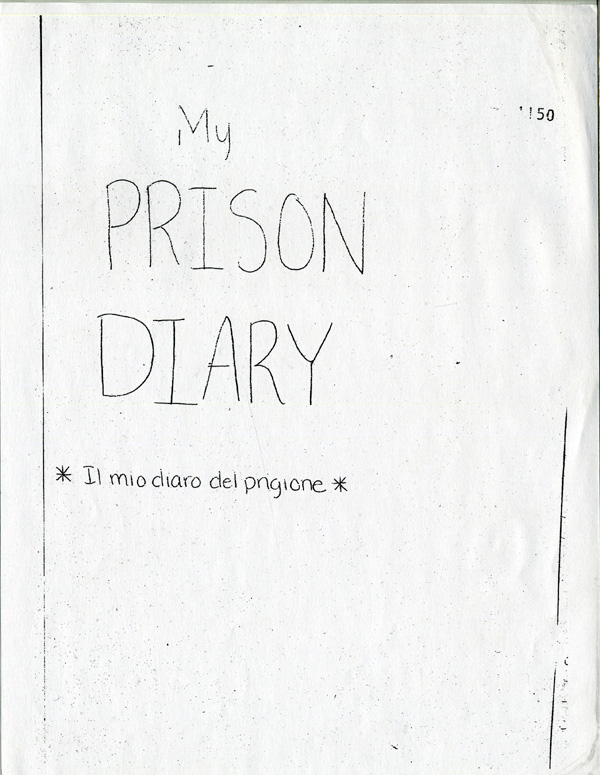 To the Italian prosecutors and criminal psychologists who put her behind bars, Knox was worse than the average Pilgrim daughter enjoying her junior year abroad. Her unfettered libido, her self-proclaimed urge to “do what every American girl does” in Italy and “get fucked up,” was all the more damning because she was a bonafide “graphomaniac.” Or, in plain speak, a compulsive writer who nursed a pathological sense of narrative entitlement. Knox chronicled her dangerous liaisons abroad in a handwritten journal, a Myspace blog, and letters to her family and friends.
In other words, the fact that Knox was a writer, albeit one at an early developmental stage, was a sure sign that she was dangerous and even diabolical, yet more evidence that she was one of the murderous crew who took Meredith Kercher’s life.
Absurd? Of course. Ridiculous? Utterly.
Emre believes that “Knox’s real Italian growth experiences and maturation as a writer…almost certainly did not begin until she found herself subjected to ‘the routine abuses of juridical power that took place while (she) was incarcerated at the Casa Circondariale Capanne di Perugia.’”
There Knox was subjected to sexual harassment on the part of Vice-Comandante Raffaele Argirò, the prison chief of the Capanne.
 (“Would you have sex with me? No? I’m too old for you?” Argirò asks on a nightly basis.)
There’s the fake HIV-positive test result that sends Knox into an impotent rage, a self-immolating desire to “undo everything—to be out of my body, out of this prison, out of this life that had caved in on me.”
(To which Argirò gamely responds, “Don’t worry. I’d still have sex with you right now. Promise me you’ll have sex with me.”)
There’s the prison handyman who tries to sexually assault Knox while fixing a clogged drain in her cell bathroom.
 And finally, there’s the confiscation of Knox’s letters, notes, and prison diary by the police, materials that are later peddled to the Italian press in an effort to shore up prosecutor Giuliano Mignini’s accusations of graphomania. “The physical chaos” of the raid on her cell, Knox writes, “was nothing compared to the chaos in my head. They’d penetrated my innermost space.”
According to Emre, Knox’s writing – which prior to her arrest was simply “the act of recording the exotic and unfamiliar—‘just like a tourist who writes a travelogue,’ soon becomes ‘psychologically essential,’ an act of willful self-preservation.”
Thus, Emre detects an essential difference between the first half of Waiting to Be Heard which still falls into the general category of “chick lit” and the “stronger, darker second half.”
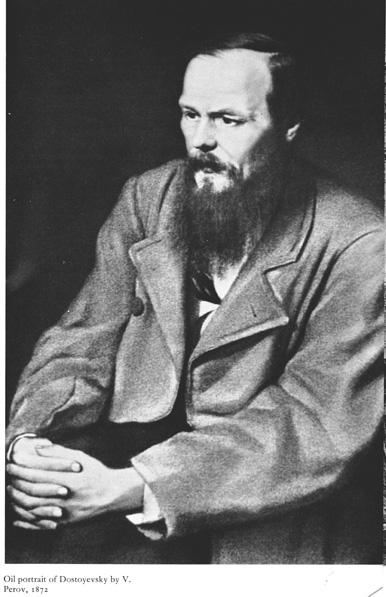 In prison Knox prefers books with characters who are lost in the ‘surreal, existential way,’ fictional models of how life on the inside recalibrates one’s sense of self. She now claims to prefer hefty novels such as Dostoyevsky’s The Possessed and Solzhenitsyn’s The First Circle over chick lit goddess Jackie Collins or other YA fare. (One is tempted to point out that desperation drove Knox to acquire a literary and linguistic education superior to anything Perugia’s School for Foreigners had to offer.)
Emre believes that prison transformed “Knox into a new person, and a literary subject to boot.”
In effect, Emre posits that the essential virtue of Waiting To Be Heard is that the second half of the book constitutes a genuine and powerful prison memoir in which she:
(O)ffers her readers brief yet jarring vignettes that panoramically reveal the population of the women’s prison as the disempowered dregs of Italian society. Without any explicit theorizing on Knox’s part, it becomes 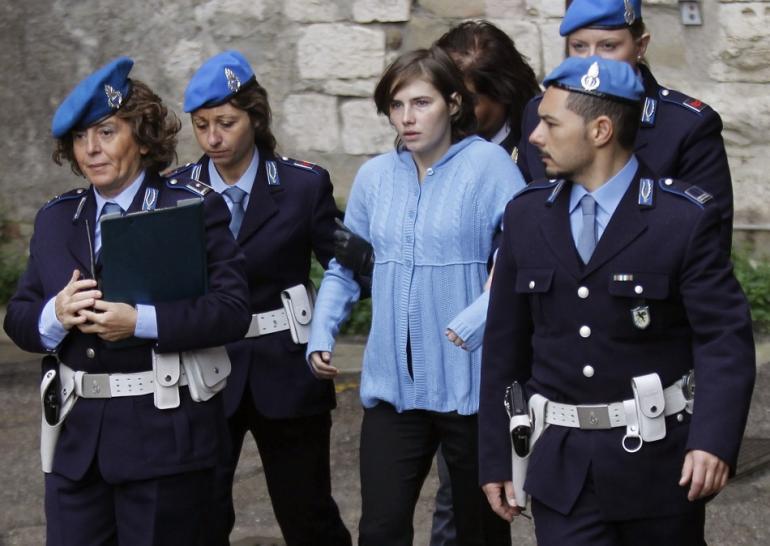 abundantly clear from the examples culled from her prison diary how virulently patterns of social oppression—sexual, racial, and class-based—are reproduced by the prison’s discourses of criminality: Cera, Knox’s bisexual roommate for some months, is in jail for allegedly murdering her boyfriend, a crime the wardens interpret as a symbolic rejection of heterosexuality; Pica and Falda are zingare outcasts (a derogatory term for Roma) and petty thieves who insist that the earth is flat; Laura, Knox’s closest friend and guardian, is a fellow American citizen turned accidental drug mule by a scheming Italian boyfriend. Most heartbreaking of all is the story of Gregora, an illiterate mother for whom Knox writes letters, and her toddler Mina. In one of Knox’s darkest days, Mina is placed in an orphanage when Gregora—who cannot “read, write, add, or subtract,” let alone defend herself in a courtroom—is unable to calculate her child’s birthday. What Mina’s fate will be, we can only imagine.
Emre does not fail to point out — lest this become an Amanda Knox cheering session – that the young American woman and her prison memoir do have their blind spots:
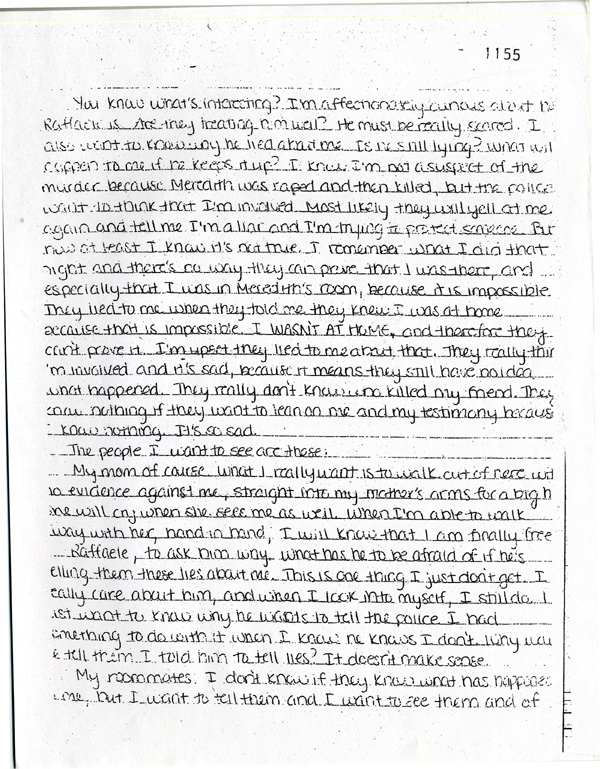 But like all prison memoirs, Knox’s has its blind spots. Most problematic is how she accounts for—or rather, fails to account for—her own biases as a privileged white exchange student in Perugia, the barely veiled racism that prompted her to finger her former boss, club owner Diya “Patrick” Lumumba, as the perpetrator of the Kercher’s murder. Unsurprisingly, Knox refuses to acknowledge it as such, choosing to attribute her false accusation to the coercive interrogation tactics of the police. It was their roughness, she claims, that led her to believe she was “deeply disturbed and very frightened of Patrick, the African owner of . . . Le Chic.
* * * * *
Thus, although clearly fascinated by Knox’s maturation and her perhaps remarkable growth while incarcerated, Emre hardly falls into the trap of failing to point out that sensitive though she is, Knox is disturbingly blind to her own entrenched white, middle-class sense of entitlement.
However, Emre finds that this shortcoming is to a large degree transfigured by Knox’s clear awareness that although she has been imprisoned, abused and – in a sense – left for dead with the rest of society’s outcasts, she never forgets that in comparison to Meredith Kercher, she is still “the lucky one.”
Emre writes:
 Perhaps this is the saving grace of Waiting To Be Heard. While her ordeal is indeed excruciating, Knox never forgets, “With all I’m going through I’m the lucky one”—an empathetic sentiment, but also a self-renouncing one, implicitly taking to task the misguided impulses of trashy exposés and good investigative journalism alike. For Knox’s account is the only one that insists on remembering Kercher, as it revisits the senselessness of her death in myriad passages rooted in Knox’s anger, sadness, and desire for justice.
At its most mature moments, Waiting To Be Heard is a convoluted apology to Kercher’s family, a gesture of symbolic atonement that Knox never had a chance to convey personally and was dissuaded by her lawyers from delivering in writing. As her appeal approaches, she drafts a letter to the Kerchers that never makes its way into their hands, but it is reproduced in the book, with the same intention to communicate. “I’m sorry for your loss, and I’m sorry it’s taken me so long to say so. . . . In the relatively brief time that Meredith was part of my life, she was always kind to me. I think about her every day.” Reading Waiting To Be Heard, one comes to appreciate more fully the tragedy of Kercher’s death through this tragic interlude in Knox’s life—her terrible journey to her grown-up self.
* * * * *
 It’s time to dispel once and for all the foolish and childish notion that Amanda Knox is simply a selfish, empty-headed “narcissist” who doesn’t give two damns about anyone other than herself. Rather, she is an “American girl” who has been unalterably transformed by her horrific ordeal, an ordeal that is still ongoing. While I cannot predict where it will lead, I can state with certainly that Knox – whether or not she took part in the murder (and I want desperately to believe she did not) – although flawed like the rest of us, is now a stronger, wiser and more humane person than she was before this all began. She has been, for all intents and purposes, transfigured by her remarkable journey.
It will be interesting to see — assuming she is acquitted – if Knox is able to contribute further to the body of literature as she moves forward in life. Writing so as not to die is a time-honored Continental tradition and Amanda Knox has apparently joined the ranks of its able practitioners.
If you enjoyed this article, please consider sharing it!



Well, I have to admit that I have not yet read her book, but only a couple of reviews (excluding yours; but this piece is the review of the review). Hundreds of factual errors has been pointed out by several experts but we are discussing the Author Knox here, right?
I have read the Myspace stories but they appeared to me as assignments written for a school exam. Typical stuff, ok.
Review of a book by a student of creative writing by another student is now being reviewed by an expert criminal lawyer.
Who is the Potter, pray, and who the Pot?
I hope you are not being sarcastic when you write “…left for dead with the rest of society’s outcasts, she never forgets that in comparison to Meredith Kercher, she is still “the lucky one.””… Oh, the irony!
She would have been transformed if she were incarcerated in an American prison.
Emre gets a B+; just for trying hard.
No, “hundreds of factual errors” have not been pointed out by “several experts”. Actual experts, that is, real experts…people who use their real names and have legitimate credentials. The nutcases inhabiting the warped world that is TJMK don’t count.
My dear Chami, If you had read the post with any care it is stated in black-and-white that Amnada Knox was a typical beginning writer when she arrived in Italy, as she herself admitted. Because of the harrowing experience of being thrown into prison and having to survive, her writing and her thinking matured. It was a natural process, no more, no less, and whether you like it or not, she takes her place among the those who have written illuminating prison memoirs. She just happens to be at least temporarily famous.
I daresay that few of us have spent three or four years in a foreign prison and I also suspect that few of us would want to.
I did not write “…left for dead with the rest of society’s outcasts, she never forgets that in comparison to Meredith Kercher, she is still “the lucky one,””, Yalie Merve Emre, who is obviously a skilled writer with considerable education, wrote it, although Knox wrote “I am still the lucky one.”
And no, none of us are being ironic.
There is an inherent irony, however, herein, the fact that for Knox to mature as a writer, she had to go through hell.
PHM
Let me reply pointwise. Too many questions you have mentioned and I have too little time…
I have read quickly but carefully. At a broad level, your points are valid but I shall dissect your responses the same way (the defense lawyer does). Please bear with me:
“Because of the harrowing experience of being thrown into prison and having to survive, her writing and her thinking matured”
European prisons are five star hotels compared to American prisons and conditions in some of the American prisons have been reported as inhuman and degrading. And for females…
I have not noticed much maturity in her writing. This may be a personal opinion. But what is the evidence you have that her thinking has matured?
Finally I strongly object to your drawing the correlation “Because” of this, she matured. If your hypothesis is correct, is there any evidence you can quote that harrowing conditions promote intellectual maturity?
In the next sentence you mention that it is a natural process. It is confusing to assume that a harrowing experience in a prison is a natural process.
I skip few other points here…
“she takes her place among the those who have written illuminating prison memoirs”- very vague and some examples of “those” who have written illuminating prison memoirs may be mentioned (also we also need some evidence that those who have written illuminating prison memoirs have accepted her as one of them).
“I daresay that few of us have spent three or four years in a foreign prison and I also suspect that few of us would want to”
In this particular case, we are discussing a third party evidence. Millions have (a guess value; exact number is not relevant for this point) spent more than 3-4 years in a foreign prison (taking the whole world). For example, given a choice, would you like a spend a year in an American prison or a in a Norwegian prison? The point is that foreign prisons may be more preferred to many. Many have biologically matured in a prison but I am not sure about their intellectual maturity.
I skip a couple of related points here.
I am fully aware that you quoted from someone else’s work but I digress. You quoted because you believe in the basic idea in the statement. The outcasts of poker flat- remember that? Unless you treat these outcasts as one of us, you are not being creative, far from being a writer. Also, I see that Merve Emre, is still a student, yet to finish her education and I have not read any of her works and I have no comments on her review. I made a comment on the review (by PHM) of the review (by YME) of a controversial work (by AMK).
I meant that fate is being ironic. I am sorry that I was not clear enough.
To mature as an adult has been painful to many of us. I do not believe that she went through hell.
Why is it that squalid murders involving drugged-up Americans always inspire such pretentious ‘writing’?
Let’s be honest, all of this is pseudo – intellectual BS designed for stupid students – the kind who ‘study’ creative writing because they’re not clever enough to cope with proper subjects like law or mathematics.
Knox was patently involved in this horrific murder – at the very least as someone who lied about it in order to try and send an innocent man to prison. Her conviction for perverting the course of justice can no longer be appealed, and now we’re waiting to hear if her second appeal against her actual murder conviction is successful.
Knox is clearly not very bright, and irrefutably rather nasty. All quite simple really – we really don’t need pompous ‘articles’ like this which try to complicate matters.
I love stories about “squalid murders involving drugged-up Americans,” or squalid murders involving drugged-up people anywhere. So do millions of other people, judging by the success of crime fiction and true crime books.
But I enjoyed your comment. In fact, I’m laughing my ass off.
This Emre person is cited as if she were something more than just another commenter. She’s a graduate student. I personally know at least five professors who regularly blog on the case, as well as innumerable authors, lawyers, doctors and scientists from around the world. My opinion (and I am no less credentialed than Emre) is that Knox was, is and always will be a bad writer. That has nothing to do with the evidence against her.
The accusations against Argiro and the others are unproven. Knox on the other hand is a convicted slanderer. She was well aware that her HIV result was likely a false positive and needed confirmation. The PR campaign chose to make a big deal out of it (even going so far as to shop that page of her diary to the media) because they knew it would resonate with her fan base.
Of course you believe Knox to be a bad writer, your bias wouldn’t allow for any sentiment other than complete rejection of that notion to prevail. That is rather obvious.
You pro-guilt advocates keep wanting so badly to point out her conviction of slander in just about every possible context. The idea that you or anyone in this life has not slandered another is patently ridicules. I reject that conviction as having merit to your narrative of her guilt simply because a judicial system affords the players the ability to convict an individual for lying simply on their word. It was a stick they used to retaliate. That you are blinded by the use of that stick, and the implication it holds for the citizens that must deal with such a system, is simply a matter of convenience to your desires. The belief that she obviously deserves whatever befalls her, no matter how irrational or egregious.
By your definition nothing she states has validity because of that slander charge. A convenient pro to your blindness. But being that you have most likely slandered another in your lifetime, your contentions with regard to her contentions should be afforded the same consideration…..suspect.
Even if Amanda Knox is guilty of murder, I still wholeheartedly support her literary efforts. In fact, I might support them even more. Murderesses should be encouraged to write books. Most likely, they will be fascinating.
If only Daisy Miller had gone off to Europe to commit crimes, then Henry James’s story would have been really something.
As much as we might try to demonize criminals, most of them are just people, same as all the rest of us. Monstrous Hannibal Lecter types are few and far between. We have much more in common with the average defendant or convict than we might like to admit. So I prefer to empathize, rather than demonize. Amanda Knox could be any of us, really. She has probably been considerably more well-behaved than I was in my youth.
And let’s not forget that much of the world’s great literature has been written in prison. Dostoevsky and Solzhenitsyn produced classic works behind bars. There’s also Sade’s 120 Days of Sodom, and Genet’s Our Lady of the Flowers. Even Don Quixote, I think, was begun in prison. Closer to home, both George Jackson and Henry Lee Abbott wrote high quality prison lit. Damien Echols’s recent book about spending 20 years on Death Row following his wrongful conviction is a stunning piece of writing. I’m sure there are others I’m unable to recall off the top of my head.
Ultimately, I hope Knox is acquitted, so she can live freely as a writer and a libertine. No matter what the result of her trial, though, I hope she keeps on writing. “Narrative entitlement?” Hell yes, and why not?
Oh yeah, and one last thing: Screw the Italian legal system. With an acid-tipped phallus. It seems to be just as bad as (or even worse than) ours here in America. Does not deserve our respect.