
Crime Talk — Language to Live and Die By
by Patrick H. Moore
People spend a great deal of time talking about crime, reading about crime, and watching crime on TV and in the movies. It’s a primary obsession in our society. Crime fiction is so ubiquitous that one can only read a fraction of what is out there. Film noir was king in the ‘40s and ‘50s and still spins its web. In literary crime, first we had the pulp crime novel, then the great age of the mysteries, and now the open-ended supremely unpredictable crime thriller. The field is constantly evolving and long may it run.
 We love the characters — the jaded protagonists who have seen too much and crossed the line one too many times; the femme fatales with their hard and stubborn eternal allure; the desperate man who’s used up all his alibis and is looking over his shoulder while he runs for his life. These characters reflect our fears and fantasies while simultaneously providing us with that necessary escapist jolt that quixotically keeps us sane in an insane world.
Part of what we love (and the subject of this post) is the language, the crime talk, the words that come out of the mouths of characters and spring up off the page, the linguistic stew that grinds its way into our memory channels. Consider the following clearly contrived selection:
“The bent cop jacked a hustler and copped his bean-shooter and his jailbait too but she turned out to be a canary and now he’s cooling his heels in stir.”
Although translation is probably not necessary, humor me just for a moment:
“The corrupt policeman robbed a billiards player and left the premises with his under-aged girlfriend but she turned out to be an informant and now he is serving time in prison.”
Which do we prefer? Most likely the former. At the very least, it’s entertaining while the latter sounds quite ordinary.
Wicked fun with language is a kick. Now let’s examine two classic selections from the annals of crime fiction. You’ll note that the authors use figurative language far more sparingly than in the two above examples:
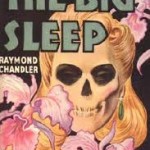
 What did it matter where you lay once you were dead? In a dirty sump or in a marble tower on top of a high hill? You were dead, you were sleeping the big sleep, you were not bothered by things like that. Oil and water were the same as wind and air to you. You just slept the big sleep, not caring about the nastiness of how you died or where you fell. Me, I was part of the nastiness now. Far more a part of it than Rusty Regan was. But the old man didn’t have to be. He could lie quiet in his canopied bed, with his bloodless hands folded on the sheet, waiting. His heart was a brief, uncertain murmur. His thoughts were as gray as ashes. And in a little while he too, like Rusty Regan, would be sleeping the big sleep. The Big Sleep by Raymond Chandler
Or try this quote from James Crumley, The Last Good Kiss:
“When I finally caught up with Abraham Trahearne, he was drinking beer with an alcoholic bulldog named Fireball Roberts in a ramshackle joint just outside of Sonoma, California, drinking the heart right out of a fine spring afternoon.”
Part of the beauty of crime talk is its versatility. The prose of Dennis Lehane is a good example. Our own BJW Nashe breaks down Lehane’s language in a Post entitled: “Best Crime Fiction: Twelve Remarkable Crime Novels.”
“His prose can veer from rock hard to razor sharp, to cynically humorous, to richly poetic — often in the same paragraph. This is American realism striving to achieve the scope and grandeur of Greek tragedy within a rock-solid crime novel framework.”
The traditional mystery and the modern suspense thriller lend themselves to trenchant social and political commentary. Jerry Stahl provides the following from Painkillers:
 “Prison was full-up with gangsters and hit men. But these were all small-timers. The real mass practitioners were the ones who ran the country. I had the feeling the old German was thinking the same thing.”
In a similar vein, consider this brief passage from a little-known crime novel called The Mental Health Club:
“The thing is the police have a tendency to blame things on the little guy, the hapless fool with no protection. That’s the way the world works. You know that. The strong run roughshod over the weak and helpless. The hired guns in the middle protect the interests of the strong. They drive the bulldozers while the big guys manicure their fingernails.”
And of course crime talk can provides good advice for healthy living. In A Walk on the Wild Side, Nelson Algren opines:
“Never play cards with a man called Doc. Never eat at a place called Mom’s. Never sleep with a woman whose troubles are worse than your own.”
Once again The Mental Health Club weighs in:
“He was kind of like a father figure.” Nick almost broke but caught himself. “Listen, Frank, I got a couple of things to tell you.” Nick spoke slowly and deliberately, nodding his head to punctuate the words. “You asked me in your email if friendship can ever be real. Well, I think I got the answer. Here in the dust and blood. These guys standing by my side. The dead man up on the hillside. These guys are my friends. That’s the answer to your question.”
 But, there is inevitably the problem of inappropriate language. Crime talk is about as far from PC as one can get these days which is part of what gives it its raw urgency and potent force. On the other hand, that same refusal to bow to any kind of censorship can be a problem. For example, it’s hard to imagine James Ellroy’s White Jazz being assigned to a college literature class, despite the novel’s obvious literary, sociological and historical merits. In a perceptive take on White Jazz, the critic Icepick writes:
But Ellroy’s heavy use of derogatory slang* terms for Blacks especially stands out to the modern reader – one just doesn’t SAY that kind of stuff anymore. If someone asks a question which has an affirmative answer, the person being questioned invariably responds “Can n*****s dance?” Whenever anyone is going to the Black section of LA it is referred to as N*****town. And since all the characters are jazz fiends someone is always going to that part of town. It actually reminds me of listening to my father and his buddies in construction talking back in the day – a “reckless verisimilitude” matches reality to a ‘T’.
Similar accusations have been leveled against Quentin Tarantino beginning as far back as “Pulp Fiction” and continuing right up through “Django Unchained.” The popular society critic Perez Hilton recently posted an interview with Tarantino which addresses this:
The famed director explains:
 “Well, you know if you’re going to make a movie about slavery and are taking a 21st-century viewer and putting them in that time period, you’re going to hear some things that are going to be ugly, and you’re going see some things that are going be ugly. That’s just part and parcel of dealing truthfully with this story, with this environment, with this land.”
Quentin went on to say that his goal was not to make viewers comfortable, but for the film’s words to feel like ” a big, gigantic boulder, a jagged pill” with no glass of water to help wash it down.
Tarantino’s thoughtful response implies that, in some instances, verisimilitude, and its byproduct, relevant social commentary, cannot be achieved without employing language that many will find offensive.
The fact that Crime Talk can certainly offend, in addition to titillating and even delighting a well-tuned ear, stands as still more evidence of its extraordinary versatility.
If you enjoyed this article, please consider sharing it!



Raymond Chandler, Dashiell Hammett, Ellery Queen and many more, were masters of dialogue and not restricted by PC, but ironically, by sex and cursing censorship. So they had to find another way to tell hard dialogue and gripping story’s.
Elmore Leonard, Walter Mosley, Eddie Bunker, James Ellroy, John D. MacDonald and Quinten Tarantino also pay little or no attention to the cult of PC. But that’s the beauty of writing; to find the truth of the moment, the truth of your story and to ignore the hysterical ramblings of those that are too afraid to speak their truth, and the truth of society.
Patrick, another great article, mate.
Thanks for the kind words, Max. Say, you’re a heckuva good writer yourself. Perhaps you would consent to write a guest post or two for us. Any crime tie-in — could be crime and indie films.
Wonderful words Max & yes, another great article Patrick.
I love classic film noir. Hitchcock immediately comes to mind.
The crime genre in film is here to stay. Even the Coen Brothers have paid homage to some of the great writers of the past.
It pains me to see crime films now being released based merely upon violence alone.
Thanks, Erick. This was a fun one to do. I agree with you that turning the crime film into a mere blood bath was a unfortunate step within the genre.
By the way, you’re also a good writer. Would you have any interest in knocking out a guest post or two? Please let me know.