
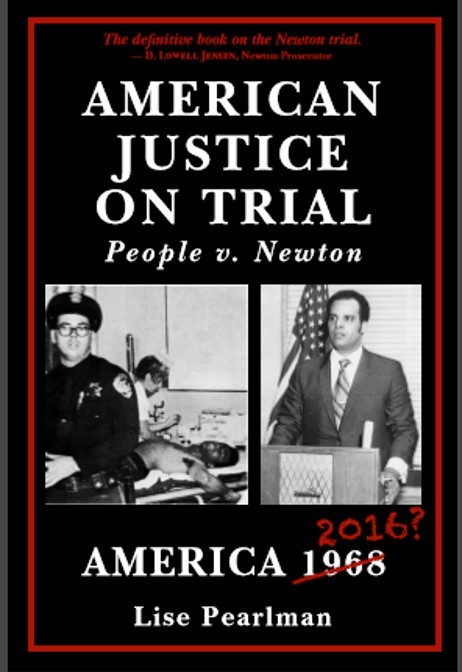
“American Justice on Trial: People v. Newton” – the untold story by Lise Pearlman
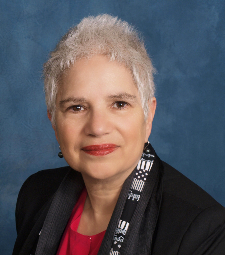 Lise Pearlman is a retired California judge and award-winning author who appeared in Stanley Nelson’s 2015 film, “The Black Panthers: Vanguard of the Revolution” as the country’s leading expert on the 1968 Huey Newton death penalty trial. You can find a description of her four critically-acclaimed history books and bio at www.lisepearlman.com. She is currently producing a nonprofit film project, “American Justice on Trial: People v. Newton.” It is a companion work to the prize-winning book All Things Crime Blog has asked her to write about in an exclusive series of blogs. © Lise Pearlman
American Justice on Trial: People v. Newton – the untold story by Lise Pearlman
This year marks the 50th anniversary of People v. Newton, the internationally-followed death penalty trial of Huey Newton, co-founder of the Black Panther Party. 1968 was one of the most turbulent years in that century. Those of us college-aged at that time would agree with TIME magazine’s assertion — 1968 was “the year that shaped a generation.” Before the shocking assassinations of Martin Luther King and Senator Bobby Kennedy, there was already substantial unrest over both the Vietnam War and the nation’s history of race bias.
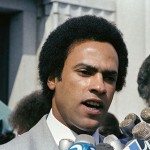
 It was in the context of abusive police practices stretching back two decades that the Black Panther Party for Self-Defense was formed in October 1966. By 1968, it spawned branches across the country — using the international attention drawn to the Newton death penalty trial as the Party’s launching pad. Even to this day the influence of the Panthers is felt, as reflected in the extraordinary popularity of Stanley Nelson’s 2015 film, “The Black Panthers: Vanguard of the Revolution” and the sell-out crowds who flocked to the extended run of the 2016-17 golden anniversary retrospective on the Black Panther Party at the Oakland Museum of California. The Panthers were the spiritual –and sometimes literal — grandparents of the current Black Lives Matter Movement.
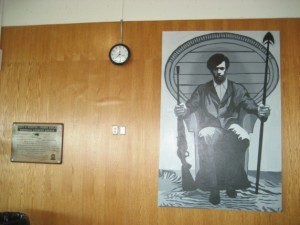 Newton seated on a wicker throne with a spear in one hand and rifle in the other has become a lasting icon symbolizing black militancy. (The photo is of a painting hanging in Oakland’s Merritt College Student Lounge dedicated to former students Huey Newton and Bobby Seale). Newton undoubtedly inspired the Oakland-based character Erik Killmonger in the 2018 blockbuster Marvel comic feature film “Black Panther” directed by Oaklander Ryan Coogler.
But my book focuses on the untold story of the Newton trial – its lasting impact on the system of justice, primarily in their demand for a true “jury of one’s peers” in criminal cases, and what it suggests regarding the critical role of diversity in further needed reforms to our justice system today.
The Sixth Amendment to the Constitution promised criminal defendants a “jury of one’s peers” but never effectively delivered on that promise from the eighteenth century to 1968. Instead, until the Newton trial it had been customary, particularly in death penalty cases, to seat white men exclusively, or with token participation by women and minorities. Nor were jurors questioned strongly about race bias. Newton and his lawyers changed all that. That one widely-watched trial would wind up revolutionizing the approach of defense counsel in seating criminal juries nationwide. It is a key reason — but not the only reason — I have argued that it should be recognized as “THE TRIAL OF THE 20th CENTURY.” All the ground-breaking aspects of the 1968 Newton trial are included in my two books on the subject: The Sky’s the Limit: People v. Newton, The REAL Trial of the 20th Century? [Regent Press 2012] and American Justice on Trial: People v. Newton, [Regent Press 2016].
The 1968 murder trial of Huey Newton is now recognized as “a world-changing true story.” I am pleased to share that my book American Justice on Trial won a 2017 award for best book on Law and was named a finalist in Multiculturalism and U.S. History. Just this month, it was also named a finalist for the 2018 Next Generation Indie Book Awards in the category of “Current Events/Social Change.” So I want to share with you why this is such an important story to revisit now.
Let’s begin my weekly blog entries with the “Author’s Note” to the book when it was released in the fall of 2016. I believe my observations then remain acutely relevant today:
As I write this, the nation is still reeling from multiple shocks in July 2016. First, as the month began, came yet two more videotaped incidents of police shooting to death black arrestees after many other such widely-publicized incidents over the previous several years. The day after the Fourth of July holiday, disturbing footage went viral of Baton Rouge police outside a convenience store firing repeatedly at 37-year-old Alton Sterling while two white policemen already had Sterling pinned face down on the ground. A day later, a thousand miles away in a suburb of St. Paul, Minnesota, the quick-thinking girl friend of Philando Castile used her cell phone to capture a local policeman still waving his gun outside Castile’s car window as Castile lay bleeding to death seated beside her following a traffic stop. This graphic image was followed within days by breaking news of a horrific sniper attack on Dallas policemen who were monitoring one of many Black Lives Matter protest rallies prompted by the deaths of Sterling and Castile. Then, on July 17, 2016 came another attack, this time on Baton Rouge police.
The carnage and proliferation of demonstrations and hostile reactions in the aftermath have drawn renewed national focus to fractured police-community relations in cities across country, the very issue that gave rise to the Black Panther Party a half century ago. Indeed, the day after video footage went viral of Castile dying from gunshot wounds following a traffic stop, AlterNet reporter Alexandra Rosenmann drew a direct comparison to the sensationalized 1968 murder trial of Panther Party co-founder Huey Newton. Rosenmann titled her web article, “Gun Rights, Police Brutality and the Case of the Century: Philando Castile’s tragic case of police brutality pulls one of the most famous cases back into focus.” (Alexandra Rosenmann, “Gun Rights, Police Brutality and the Case of the Century,” Alternet, July 7, https://www.alternet.org/civil-liberties/gun-rights-police-brutality-and-case-century-video.)
The two incidents did start out in similar ways. In the early morning of October 28, 1967, Oakland policeman John Frey stopped the car Newton was driving to write a ticket for an unpaid traffic fine. A shootout ensued that left Officer Frey dead and Newton and a back-up officer seriously wounded. Newton claimed to have been unarmed and the victim of an abusive arrest; no gun belonging to Newton was found. His death penalty trial the following summer drew international attention to whether any black man could get a fair trial in America.
Before the deadly July 2016 incidents occurred, interviewees for this book had already noted the remarkable relevance of the 1968 Newton case to current events. Among them is William “Bill” Patterson, a former President of the Oakland NAACP and the first black foreman of the Alameda County Grand Jury: “It does resonate today. A young man [Oscar Grant III] being killed in the BART station by BART police and how that played out. The Florida case . . . again another young man [Trayvon Martin] shot to death. These situations continue to emerge and if we are not careful, we will find history repeating itself.”
In the past several months, both champions and critics of the Black Lives Matter movement have drawn parallels to the split among Americans in the turbulent 1960s. The comparisons reached a point where President Obama felt compelled to reassure the world, on July 9, 2016, that most Americans are not as divided as we were fifty years ago: “When we start suggesting that somehow, there’s this enormous polarization and we’re back to the situation in the ’60s, that’s just not true. You’re not seeing riots, and you’re not seeing police going after people who are protesting peacefully. . . . We’ve got a foundation to build on . . .” (Kathleen Hennessey, “Obama asks Americans not to fear a return to a dark past,” Associated Press, July 10, 2016) [http://bigstory.ap.org/article/ad7321415b1d4e6a91d2f98e2f9ba81d/obama-take-questionsdallas-attack-race-relations.]
President Obama himself symbolizes the profound change in the fabric of our nation over the past half century. So, too, do black police chiefs like Dallas Police Chief David Brown. Chief Brown’s reaction to a black gunman ambushing randomly chosen white officers on the evening of July 7, 2016, captured the sentiments of most Americans: “We are heartbroken. There are no words to describe the atrocity that occurred in our city. All I know is this must stop: this divisiveness between our police and our citizens.” (Greg Hanlon, “Police Chief David Brown on Dallas Ambush of Officers: ‘All I Know Is This Must Stop,’” People: True Crime, (quoting Dallas Police Chief David Brown. July 7, 2016). [people.com/crime/dallas-ambush-police-chief-david-brown-says-all-i-know-is-that-this-must-stop/]
This book scrutinizes the 1968 Newton trial and its context and poses the same questions President Obama and others have recently addressed: what has changed in this country in the last half century and what has not? How do we best move forward?
Lise Pearlman
Oakland, California
September 2016
Update May 2018: We can add several lethal police shooting incidents in the last twenty months to those I cited in 2016 and more violent protests and counter-protests. We are exhibiting far greater polarization as a nation than President Obama observed in 2016 and than I, or probably most of us, imagined could take hold just two years ago. The about-face in Washington by President Trump and Attorney General Sessions on Obama-era criminal justice policies and priorities clearly played a large role in ramping up the intensity of racial divides. Yet the two questions I asked then are equally relevant now. What has changed in this country in the last half century and what has not? How do we best move forward?
Click on the links below to select books by Lise Pearlman:
The Sky’s the Limit People V. Newton, the Real Trial of the 20th Century?
CALL ME PHAEDRA: The Life and Times of Movement Lawyer Fay Stender
If you enjoyed this article, please consider sharing it!






Great post, Lise! Can’t wait to read your book.
Ms. Pearlman will be doing a series of ten posts in which she will re-tell the story of Huey Newton’s trial and its aftermath…
I think those two questions are very important. I wasn’t alive in the late 60s but lived in the San Francisco Bay Area during the time of the Oscar Grant riots. There is this idea that we have moved on from a previous era of a criminal justice system that was deeply flawed, but recent actions, if anything, have shown that there is still a deep level of institutional racism even with subtle but wide ranging acts that carry significant implications, such as two black males having the police called on them while waiting at a Starbucks. If anything, Donald Trump’s election and rhetoric has ratcheted up a previously veiled racist orientation within the country and in doing so vocalized a legacy of problematic scapegoating and xenophobia that continues to challenge the fabric of what this nation was founded on.
Excellent comment, SB! It has been a shock to discover that racism in America, which I cavalierly thought was now less egregious than it had been in the dark days of the past, is still so virulent and unrelenting.
[…] “American Justice on Trial: People v. Newton” – the untold story by Lise Pearlman […]
[…] “American Justice on Trial: People v. Newton” – the untold story by Lise Pearlman […]
[…] “American Justice on Trial: People v. Newton” – the untold story by Lise Pearlman […]
[…] “American Justice on Trial: Folks v. Newton” – the untold story by Lise Pearlman […]