Beat Icon William S. Burroughs: A Thanksgiving Prayer and Spiritual Journey
by BJW Nashe
On Thanksgiving Day, November 28, 1986, renowned Beat novelist and counter-cultural icon William S. Burroughs delivered a “Thanksgiving Prayer” to the nation. Dedicated to John Dillinger, “in hoping he is still alive,” the prayer is a vitriolic smear laid over all of America’s worst attributes. In effect, Burroughs is saying thanks very much for the violence, racism, oppression, and homophobia. Filmmaker Gus Van Sant later made a short video montage featuring Burroughs reciting the poem in his characteristically deadpan Midwestern drawl:
http://www.youtube.com/watch?v=sLSveRGmpIE
 No doubt this is pretty strong medicine on Thanksgiving — sort of like stuffing the roast turkey with arsenic. One problem is that the prayer has little of the dark, wild humor that makes Burroughs’s most caustic writings a bit more palatable. And while few of us can deny that the problems he refers to are terrible, and that the genocide of Native Americans tends to be conveniently forgotten on Thanksgiving, by lashing out on a national holiday Burroughs risks coming across as an angry, bitter, resentful old man — which, for various reasons, personal as well as political, is precisely what he was even as late as 1986. Thus it becomes tempting to overlook the substance of Burroughs’ message, and view the Thanksgiving Prayer as something best suited for a psychiatrist’s office, rather than the public airwaves.
The bitterness of the Thanksgiving Prayer, however, was not the final stop on Burroughs’s long journey. Naturally, it is the incendiary subject matter — the drug addiction, the criminality, the homosexuality, the avant-garde writing, the radical ideas — that tends to dominate most discussion of his life and work. Less well-known, perhaps, is the remarkable transformation Burroughs underwent during the last several years of his life. This transformation should be just as important to the Burroughs legacy as the deep scorn of the Thanksgiving Prayer.
In No Maps for These Territories, a fascinating documentary film starring acclaimed sci-fi author William Gibson, the topic of Burroughs inevitably comes up. Gibson, a longtime fan of the Beat icon’s ground-breaking work, observes that Burroughs, in spite of a lifetime of pain and turmoil, toward the end of his life finally arrived at a place where he was no longer tormented, and no longer in need of synthetic pain killers. “He was OK,” says Gibson, from the back seat of a car in Vancouver. “And it was good to know that he was going to be OK.”
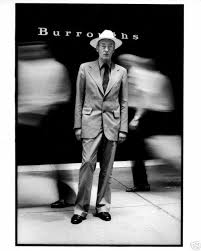 By most accounts, amazingly enough, Burroughs was even better than “OK” at the end of his life. Sometime after he settled down in Lawrence, Kansas, the notoriously cold, heartless writer began to change dramatically — so much so that as he neared death he achieved a kind of peace and serenity that he never thought possible before. This is expressed simply and poignantly in the final entry in his journal, written just days before his death in 1997, in which he states that love is “the most natural painkiller that there is…” I find it incredible that Burroughs’s long, strange trip through hell culminated in a very spiritual journey into bliss. We have to wonder what happened?
The journey was not an easy one. Born in 1914, Burroughs had a privileged upbringing in St. Louis, Missouri, but he never felt comfortable in his immediate social surroundings. A shy, bookish adolescent with gay and bisexual tendencies, he grew up to be rebellious and assumed the stance of a perpetual outsider. Blessed with high intelligence, he graduated from Harvard University in 1936 with a degree in English, and then embarked on postgraduate studies in anthropology and medicine. Yet he soon began using drugs and associating with underworld criminal types. He was denied entry into military service as many as four times. At age 25, in a state of mental duress, he severed the last joint of the little finger on his left hand, subsequently telling a psychiatrist that the self-mutilation was “part of an initiation ceremony into the Crow Indian tribe.”
As a young man out of college, Burroughs worked a series of odd jobs in New York, including stints as a bartender and an exterminator. Meanwhile, he continued his diverse studies independently. A wide range of subjects, including history, the occult, weapons, telepathy, and science fiction were all thrown into the mix. He met Jack Kerouac and Allen Ginsberg, both students at Columbia University, who would remain longtime friends. He married a woman named Joan Vollmer, a free spirit who was addicted to amphetamines. Burroughs much preferred opiates such as morphine and heroin, to which he was soon heavily addicted. He and Joan moved to New Orleans for a while, and they also lived on a ranch in Texas, where Burroughs tried to farm a crop of marijuana.
 Burroughs’s subsequent writing career was linked to a terrible tragedy. In 1951, he and Joan were staying in Mexico City, having fled the U.S. to avoid marijuana-related charges. During one drunken evening spent at their home with a few friends, Joan told William, “It’s time for our William Tell routine.” To amuse guests, Burroughs, a longtime gun enthusiast, would often fire at an object such as a glass that Joan had placed on top of her head. Burroughs was an excellent marksman, but on this particular night, his aim was off. He shot Joan in the head, killing her instantly.
Burroughs’s wealthy family was able to keep him out of prison in Mexico, although once the story was reported, many Americans thought he was guilty of a crime and should be prosecuted. The incident tormented him for decades. He often spoke of having a terrible premonition on the day of the incident that something awful was going to happen, which he would be powerless to stop. He also spoke of something akin to demonic possession — the invasion of a hostile spiritual force — that was at the root of his destructive tendencies. Most addicts know the feeling that something other has taken over one’s heart and soul and is now calling the shots, usually with disastrous results. They often speak of “my addiction” as if it is a separate entity working away inside their very being. Edgar Allan Poe, no stranger to addiction, referred to this self-destructive impulse as “The Imp of the Perverse.
In his confessional preface to his novel Queer, Burroughs remorsefully admits that Joan’s death was the key event in his decision to be a writer:
“I am forced to the appalling conclusion that I would never have become a writer but for Joan’s death, and to a realization of the extent to which this event has motivated and formulated my writing. I live with the constant threat of possession, and a constant need to escape from possession, from control. So the death of Joan brought me in contact with the invader, the Ugly Spirit, and maneuvered me into a life long struggle, in which I have had no choice except to write my way out.”
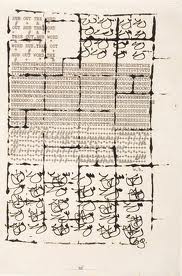 For Burroughs, writing was the only way he knew how to fight against the Ugly Spirit, frequently referred to as CONTROL, and best characterized as the dark forces that threatened to ruin his life (and all of our lives) through fear, addiction, violence, and death. He never defined these forces too narrowly, but he was able to vividly describe them at work in various contexts: political, social, sexual, medical, psychological, and spiritual. He located the Ugly Spirit in the manipulative schemes of the Western ego, in the exploitative practices of global capitalism, and in the oppressive institutions of governments and legal systems everywhere. His own personal problems, exacerbated by the accidental shooting death of Joan, were simply a localized instance of the Ugly Spirit that plagued the entire world.
Particularly fascinating was Burroughs’s assertion that the Ugly Spirit had infiltrated the structure of language itself. Hence his desire to “sever the word lines,” and produce cut-up, re-mixed texts closer to dense poetic collages than to linear narratives. If writing is a struggle against the Ugly Spirit of CONTROL, the stakes are high. Burroughs figured he might as well opt for total war. Not only did he fight against ugly social realities. He also had to fight his own addictive tendencies, which was a constant struggle. At times he waged war against linguistic meaning itself. This was not a surefire way to get on the bestseller lists, but it did result in some incredible writing that was like nothing else ever seen before.
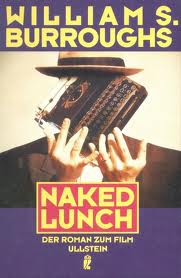 Burroughs’s masterpiece is undoubtedly Naked Lunch, a brutally satirical, hallucinatory, and often pornographic series of sketches or “routines” that deal with heroin addiction, political corruption, sexual perversion, and technological insanity. Burroughs explains in his introduction to the novel that it was written after a prolonged period of drug-induced dissipation. Published in 1957, Naked Lunch was soon prosecuted for obscenity, but the state lost the case, and the resulting controversy propelled sales of the novel. Against all odds, the author was soon famous. Living primarily in Tangier, Paris, and London, Burroughs went on to produce many more works of fiction and non-fiction. Gradually, his role changed from that of literary outlaw to senior statesman of the avant garde. When he returned to live in New York in the mid-1970s, he was treated like an underground celebrity. His public readings became a huge hit with the artists and musicians of the burgeoning punk scene. In 1983, Burroughs was elected to the American Academy and Institute of Arts and Letters, and in 1984 was awarded the Ordre des Arts et des Lettres by France.
In spite of new-found respectability, Burroughs still battled his drug addiction — often unsuccessfully — and he remained a deeply troubled, unhappy man. Ceaselessly fighting against the forces of CONTROL was taking its toll. There are only so many angry Thanksgiving Prayers one can write, no matter how evil the system seems to be. In fact, waging war against the Ugly Spirit only seemed to make the bastard dig in even deeper. There has to be something else to reach for, in order to live out the rest of one’s life in relative tranquility. Succumbing to the living death of heroin addiction was not the way to go. Maybe the whole war had to be, if not surrendered, then somehow transcended. But how?
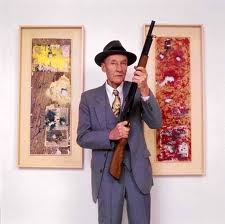
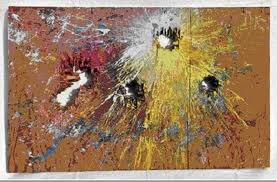 Burroughs disengaged from frantic urban life altogether, moving out of his infamous “Bunker” residence on the New York Bowery, and buying a simple, comfortable house in the college town of Lawrence, Kansas. Sticking with his methadone program, he largely stayed away from heroin. He began practicing “chaos magic,” and joined an organization dedicated to this esoteric pursuit. He wrote a powerful visionary novel called The Western Lands, which helped him come to terms with death by delving into ancient Egyptian mythologies of the afterlife. He also began focusing on artwork, producing a series of “shotgun paintings,” which he created by firing at cans of paint positioned in front of canvases. You don’t have to be a psychologist to appreciate that the paintings were at least in part a way of reclaiming and transforming the primal scene of Joan’s crime, which still caused Burroughs tremendous shame and grief. Instead of splattering her blood and brains against the wall, now Burroughs’s gunfire was creating abstract art that was quite beautiful. In addition, at this time Burroughs began connecting closely with animals. The cats which he was ashamed to admit he had abused as a young man were now his dearest friends. He had as many as twelve of them. He even wrote a book about them.
All of this was transformative. But it was a Native American-style sweat lodge ceremony that seemed to have the largest impact on Burroughs’s long spiritual journey.
In 1992, the aging novelist decided he must try to exorcise the Ugly Spirit from his body and mind once and for all. With Allen Ginsberg and a group of five other 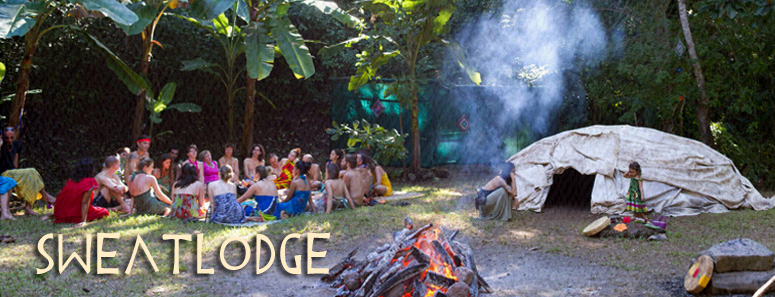 friends, Burroughs made a pilgrimage to his childhood home in St. Louis. There, the men entered a kind of special cave or hole in the ground, which had a fire pit in the middle. In this sweat lodge, the group spent hours praying, chanting, and placing hot coals in their mouths in order to swallow up the evil spirits. And it worked. All of the men believed that the ritual had been a great success. Burroughs left claiming that he was finally rid of the Ugly Spirit. All of the pain and guilt and anger and remorse that had consumed him for decades was gone. He was able to forgive himself for Joan’s death. And he was ready to finish his life in what he called “a blessed state of beatitude.” On a deep level, he understood now that love was the ultimate painkiller.
There would be no more angry Thanksgiving Prayers. Five years later, on August 3, 1997, Burroughs died of a sudden heart attack. He was memorialized around the world as a key figure in 20th century art and literature, and as a counter-cultural icon whose battle against the Ugly Spirit, and whose search for final wisdom, can serve as an inspiration to us all.
If you enjoyed this article, please consider sharing it!