

The Two Faces of Eugène François Vidocq, the World’s First Private Investigator
by Bob Couttie
If you’ve watched Les Miserables, then you will have seen Eugène François Vidocq not once but twice, as Jean Valjean the reformed criminal and as Police Inspector Javert. Why was this man, almost unknown today outside Francophile and police history circles, given two bites of the cherry by Victor Hugo in his classic historical novel set in 19th century France?
Vidocq was so influential that Edgar Allan Poe based his detective character C. Auguste Dupin on him in the classic The Murders in the Rue Morgue. In a possible fit of pique, Conan Doyle’s Study in Scarlet dismisses Vidocq under the name Lecoq as a “miserable bungler” while borrowing some of his techniques.
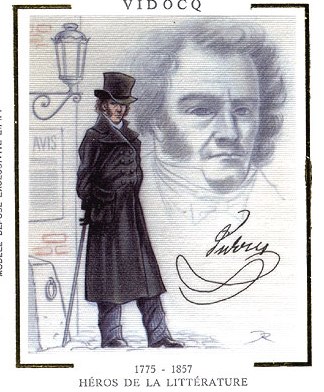 This petty crook turned cop changed the face of police work forever, developing investigation and criminal intelligence systems still in use today across the world. He established the first plain-clothes detective department and the first private detective agency. Despite being a master of self-publicity, today he is relatively obscure, a fate that would have appalled him.
He was born on 24 July 1775 in Arras, France to a fairly well-off family and grew into a wild teenager. When he was 13 he got his first taste of prison when his father had him arrested for stealing some of the family silver.
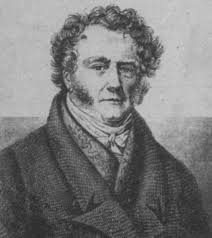 After two weeks in prison Vidocq was released, completely unredeemed. Shortly afterwards, he stole money from his parents’ bakery business and skedaddled to Ostend in Belgium with plans to sail for America. He lost the money in a scam and joined a group of entertainers to survive. It was hard work but he did get regular meals – he acted as a cannibal in a geek show in which he ate raw meat.
Eventually he returned home, broke, and joined the army. Vidocq himself claims that while in the army he challenged fourteen people to a duel, killing two of them. While in prison for two weeks for an unknown violation, Vidocq helped another inmate escape.
Although Vidocq became a war veteran, participating in two battles, his rebellious attitude made him a bad fit as a soldier. After hitting an officer, he deserted and joined another regiment. Although Vidocq escaped charges of desertion, he found himself persona non grata in the military and had to resign.
The next year brought him an unhappy marriage to a woman who fooled him by claiming she was pregnant when she was not. Vidocq claimed that he killed his wife’s lover in a duel although the story appears to be a bit of fantasy.
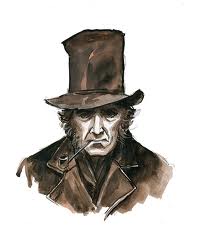 For the next 15 years, Vidocq was constantly being arrested for various petty crimes. Getting jailed, escaping and going on the run under an assumed name became his modus operandi. Once in a while he would try to go straight but somehow or other his past his past would come back and bite him.
Finally he was arrested once more on 1 July 1809. He was tired of life on the run but his past had not equipped him well to do much else, except perhaps become a police spy. He offered to become an informant. His offer was accepted but still meant he had to go to prison to collect and pass on information received from the inmates. Eventually he was released from prison under the guise of yet another escape. He then circulated in the French underworld, protected by various disguises and his acting skills.
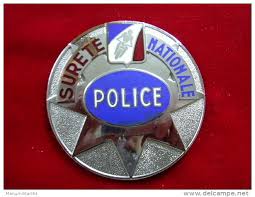 He went onto form a team of civilians, mostly criminals, and including women, to help him with his undercover work. He called it Brigade de la Sûreté – The Security Brigade. Within a year the brigade was formally made part of the French Prefecture of Police. At the end of 1812, it was recognised as a police security force and changed its name to the Sûreté Nationale. It was the world’s first plain clothes detective unit working undercover and Vidocq was appointed to head it.
The poacher had turned gamekeeper.
 He revolutionised detective work by setting up a card index of crimes, criminals and their modus operandis. He also introduced the use of indelible ink to ensure the cards could not be altered or forged, and therefore could be presented as evidence in court. That was hardly his only innovation: He used plaster of Paris to preserve a boot impression at a burglary and traced the criminal by matching his tracks to his footware.
Vidocq was also the first to use ballistics in criminal investigations.
In those days evidence was generally not used to establish guilt but to extract a confession: When Vidocq demonstrated that a bullet which had killed a woman matched a gun owned by her lover, the latter confessed. A forger confessed when it was shown he had a criminal record and handwriting evidence proved he had falsified a document.
 Vidocq was not above using fake scientific evidence to secure a confession. At one crime scene where there had been a fight, Vidocq claimed that the blood came from the attacker. He came up with a suspect, tracked him to a bar and provoked a fight through which he got a sample of the suspect’s blood on a handkerchief. When a chemical was applied both blood samples turned bright red, supposedly showing that they matched. The suspect confessed. It was a bluff on Vidocq’s part — blood typing had yet to be invented — but it secured a confession.
Vidocq’s subtle, albeit unorthodox, techniques were ahead of their time. Police of the period usually secured their confessions by merely beating their suspects until they finally caved in and told them what they wanted to hear.
After arguing with his superiors, Vidocq resigned on 20 June 1827 at the age of 52 after 18 years with the police. He set up a paper mill but ran into money problems and declared bankruptcy. By then the police leadership had changed and a new king was on the throne. Vidocq was invited back to head the Sûreté again.
France was undergoing a period of unrest and revolution. Vidocq’s organisation was accused of treating rioters badly. Some police superiors did not like his methods, or the people who worked for him, and a scandal which implicated him in robbery led to him once again resigning.
 In 1833 Vidocq went into private practice. He set up the Le bureau des renseignements, the world’s first private detective agency. Inevitably, he was looked upon with disfavour by the authorities and several attempts were made to put him out of business, including an extortion charge. Although Vidocq was cleared of the accusations, his business suffered.
He finally died at the then very reasonable age of 82. His had been an adventurous life and one that left behind a little-known legacy that still survives today.
You can check out the Vidocq Society here.
If you enjoyed this article, please consider sharing it!








Fascinating article!
I thought so too. The other early European forensics/police detective guy was the German, Mr. Gross. His son was a Bohemian but not good old dad. This would have been about the 1890s or thereabouts. Southern Germany and Austria apparently had a burgeoning counter-culture of sorts back then. The “alt” were nature worshippers, nudists, and followed the sun and the festivals. “the more things change the more they stay the same” or something like that.
I always thought Vidocq deserved to be more widely known. That’s why I gave him a name check as a computer password in Temple of the Leper King 🙂
[…] All is revealed in Bob Couttie’s article on this remarkable man. Check it out at All Things Crime Blog here. […]
Blogging is not my day job definately. Im trying to promote my
business by attempting to reveal it. But crap is it ever
difficult. I do admire your posts, and I simply had to comment to
offer you kuddos on wonderful content and information.